What the flag looks like
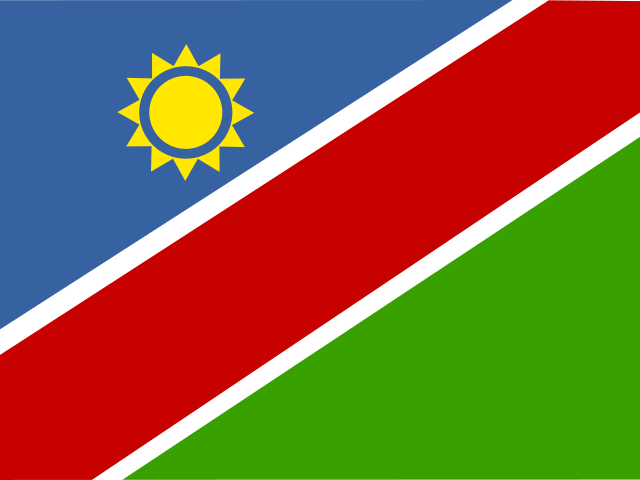
The Namibian flag is divided diagonally by a red band extending from the lower hoist corner to the upper fly corner, bordered in white. The upper triangle is blue and the lower triangle is green. A golden sun with 12 rays appears in the upper hoist corner, on the blue triangle. The proportion is 2:3. It was adopted on 21 March 1990, when Namibia gained independence from South Africa.
Colors and meaning
Blue represents the Atlantic Ocean that borders Namibia to the west and the clear sky, red represents the blood shed by Namibian patriots in the struggle for independence, green represents the country's vegetation and agricultural wealth, white represents peace and unity, and the golden sun represents life, energy and the country's bright future.
Blue
Represents the Atlantic Ocean, which borders Namibia's entire western coastline, and the clear sky over the Namib Desert — the oldest desert in the world.
Red
Represents the blood shed by Namibian patriots during the long struggle for independence, particularly during the Namibian War of Independence (1966–1990) led by SWAPO against South African rule.
Green
Represents Namibia's vegetation, agricultural wealth and natural resources. Despite the country's arid climate, the northern regions are green and productive.
White
Represents peace and unity, and the white borders of the red band represent peaceful coexistence. The design includes three white stripes that together symbolize peace.
Golden sun
Represents life, energy, hope and the bright future of the Namibian nation. The 12 rays of the sun, drawn in traditional African style, represent the country's diversity and unity.
History and adoption
Namibia was a German colony known as German South West Africa from 1884 to 1915, then was administered by South Africa under a League of Nations mandate and later in defiance of the United Nations. The South West Africa People's Organisation (SWAPO) began an armed struggle for independence in 1966. After years of international pressure and negotiations, Namibia gained independence on 21 March 1990. The flag was designed by Roy Allen, a South African artist, and was chosen in a national competition. It was adopted on independence day and has remained unchanged since.
Key facts
- Adopted
- 21 March 1990
- Proportion
- 2:3
- Designer
- Roy Allen
- Capital
- Windhoek
- Country code
- NA
- Similar flags
- Tanzania, Trinidad and Tobago
Historical and related flags
Namibia used several flags during its German and South African colonial periods before independence.
- German South West Africa (1884–1915): German colonial flags.
- South West Africa (1915–1990): South African flag used during administration.
- SWAPO flag (1966–1990): Blue, red and green with a sun, used by the independence movement.
- Current flag (1990–present): Blue, red, green diagonal design with a golden sun.
- Presidential standard: Uses the Namibian coat of arms with an eagle.
Frequently asked questions
What does the flag of Namibia look like?
The flag of Namibia is divided diagonally from the lower hoist to the upper fly by a red band edged in white. The upper triangle is blue and the lower triangle is green. A golden 12-rayed sun sits in the upper hoist corner. The proportion is 2:3.
When was the flag of Namibia adopted?
The current flag of Namibia was officially adopted on 21 March 1990.
What do the colors mean?
Blue represents the Atlantic Ocean that borders Namibia to the west and the clear sky, red represents the blood shed by Namibian patriots in the struggle for independence, green represents the country's vegetation and agricultural wealth, white represents peace and unity, and the golden sun represents life, energy and the country's bright future.
Which flags look similar to the Namibia flag?
Tanzania uses a similar diagonal design with green, black, yellow and blue. Trinidad and Tobago uses a red field with a black and white diagonal stripe. Namibia's blue, red, green and white arrangement with a golden sun is distinct.

 South Africa
 Botswana
 Zambia
 Angola
 Zimbabwe
 Tanzania