What the flag looks like
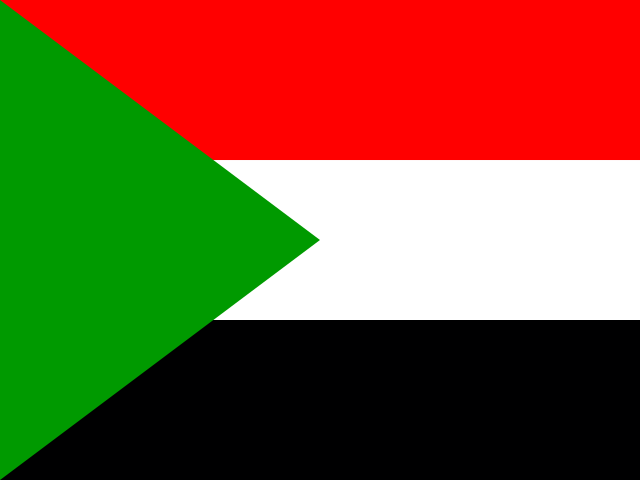
The Sudanese flag consists of three equal horizontal bands of red (top), white (middle) and black (bottom), with a green isosceles triangle at the hoist side. The proportion is 1:2. It was adopted on 20 May 1970 under President Gaafar Nimeiry, replacing the earlier blue-yellow-green flag used since independence in 1956.
Colors and meaning
Red represents the blood shed for Sudanese independence and the struggle of the Sudanese people, white represents peace, purity and hope, black represents Sudan's African heritage and the dark years of colonial rule, and green represents Islam, agriculture and the country's natural wealth.
Red
Represents the blood shed by Sudanese patriots during the long struggle for independence, and the sacrifice of the Sudanese people throughout their history.
White
Represents peace, purity and hope for a bright future for Sudan.
Black
Represents Sudan's African heritage and the dark years of colonial rule under Britain and Egypt. The name 'Sudan' comes from the Arabic 'bilād as-sūdān', meaning 'land of the Blacks'.
Green triangle
Represents Islam, the dominant religion of Sudan, and the agricultural wealth of the country. Green is the traditional color of Islam and of the Islamic Nationalist movement in Sudan.
History and adoption
Sudan gained independence from Britain and Egypt on 1 January 1956 and adopted a blue-yellow-green tricolor to represent the Blue Nile, the Sahara desert and the country's agriculture. On 20 May 1970, following the 1969 coup led by Gaafar Nimeiry, the flag was replaced with the current red-white-black tricolor with a green triangle — a design based on the Arab Liberation Flag, which had been used by several Arab nationalist movements. The design has remained unchanged since, including after South Sudan separated from Sudan in 2011.
Key facts
- Adopted
- 20 May 1970
- Proportion
- 1:2
- Designer
- Arab Liberation Flag design adopted by the Nimeiry government
- Capital
- Khartoum
- Country code
- SD
- Similar flags
- Palestine, Jordan, Kuwait, UAE
Historical and related flags
Sudan has used several flags across its Anglo-Egyptian and post-independence periods.
- Mahdist State (1885–1899): Black banners used by the Mahdist forces.
- Anglo-Egyptian Sudan (1899–1956): British and Egyptian flags used jointly.
- First flag (1956–1970): Blue-yellow-green tricolor adopted at independence.
- Current flag (1970–present): Red-white-black with green triangle.
- Naval ensign: Similar design with an anchor.
- Presidential standard: Uses the Sudanese coat of arms — a secretarybird.
Frequently asked questions
What does the flag of Sudan look like?
The flag of Sudan has three equal horizontal bands of red (top), white (middle) and black (bottom), with a green isosceles triangle at the hoist. The proportion is 1:2.
When was the flag of Sudan adopted?
The current flag of Sudan was officially adopted on 20 May 1970.
What do the colors mean?
Red represents the blood shed for Sudanese independence and the struggle of the Sudanese people, white represents peace, purity and hope, black represents Sudan's African heritage and the dark years of colonial rule, and green represents Islam, agriculture and the country's natural wealth.
Which flags look similar to the Sudan flag?
Palestine uses a red-black-white tricolor with a red triangle. Jordan and Kuwait use the same Pan-Arab colors with different triangle arrangements. Sudan's green triangle instead of red is unique among the Arab Liberation Flag variants.

 Egypt
 Libya
 Palestine
 Jordan
 South Sudan
 Ethiopia