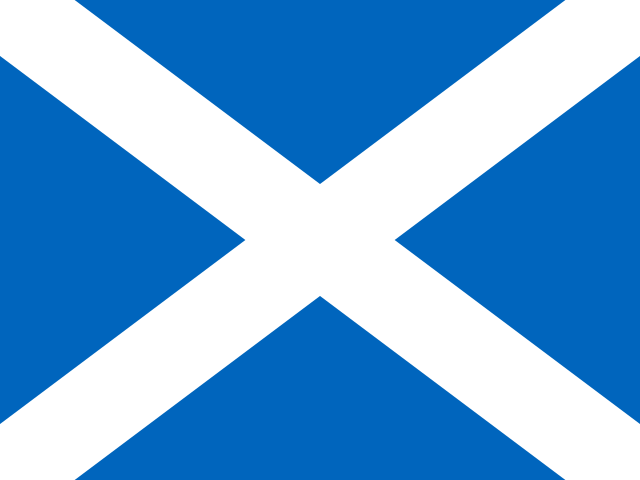
What the flag looks like
The Scottish flag consists of a blue field with a white diagonal cross — the saltire — extending to all four corners. The proportion is 3:5. According to tradition, the flag originated in 832 CE at the Battle of Athelstaneford, when King Óengus II of the Picts saw the cross of Saint Andrew formed by clouds in the blue sky on the eve of a battle against the Angles. The design has been in continuous use since at least 1512 and is considered the oldest national flag in continuous use in the world, along with the Danish flag.
Colors and meaning
Blue represents the sky over Scotland and the sea that surrounds the country's coastline, and the white diagonal cross represents Saint Andrew, the patron saint of Scotland, who was martyred on an X-shaped cross. Saint Andrew is also the patron saint of several other countries, including Greece, Romania, Russia and Barbados.
Blue field
Represents the sky over Scotland and the seas that surround the country's long coastline. The exact shade of blue has varied over the centuries — the current official shade is Pantone 300, a bright medium blue.
White saltire
Represents Saint Andrew, the patron saint of Scotland. According to Christian tradition, Saint Andrew was crucified on an X-shaped cross (a saltire) because he felt unworthy to be crucified on the same type of cross as Jesus. He is said to have preached in Scythia and possibly in Scotland, and his relics were brought to St Andrews in Fife. Saint Andrew became the patron saint of Scotland in the 9th century.
Legend of Athelstaneford
According to tradition, the flag originated on the eve of the Battle of Athelstaneford in 832 CE. King Óengus II of the Picts was preparing to fight a larger army of Angles when he saw a cloud formation in the blue sky that formed an X — the cross of Saint Andrew. He vowed that if he won the battle, he would make Saint Andrew the patron saint of Scotland. The next day, the Picts won, and Saint Andrew became the patron saint of Scotland.
Oldest flag
The Saltire is often described as the oldest national flag in continuous use, along with the Danish Dannebrog. The earliest documented use of the saltire as a Scottish emblem is from 1286, and the earliest image of a blue field with a white saltire is from 1512.
History and adoption
The Saltire has been used as a symbol of Scotland since at least the 13th century, when it appeared on the seals of Scottish nobles and on Scottish coins. According to tradition, the flag originated in 832 at the Battle of Athelstaneford. It was formally adopted as the national flag of Scotland in the 16th century and has been in continuous use since. In 1606, after the Union of the Crowns, the Saltire was combined with the English St George's Cross to create the first Union Flag. When Ireland joined the union in 1801, the cross of St Patrick was added to create the modern Union Jack. Despite this, the Saltire remained the national flag of Scotland and has continued to be flown throughout the country. In 2003, the Scottish Parliament standardized the proportions of the flag at 3:5, and in 2006, it was decided that the Saltire should be flown over Edinburgh Castle every day rather than just on St Andrew's Day (30 November).
Key facts
- Adopted
- In use since at least 1512; formalized as the national flag of Scotland in the 16th century
- Proportion
- 3:5
- Designer
- Traditional design attributed to Saint Andrew
- Capital
- Edinburgh
- Country code
- GB-SCT
- Similar flags
- None
Historical and related flags
Scotland has used several flags across its history, and related symbols are in use today.
- Saltire (medieval–present): Blue field with a white diagonal cross, the national flag of Scotland.
- Royal Standard of Scotland: A red lion rampant on a yellow field with a red double border, used by the Scottish monarchy.
- First Union Flag (1606–1801): St George's Cross combined with St Andrew's Saltire.
- Union Jack (1801–present): Modern UK flag, which incorporates the Saltire.
- Flag of the Church of Scotland: Uses a blue field with a white saltire and a burning bush emblem.
- Scottish national flag with royal arms: Used for official purposes, adds the Royal Standard elements.
Frequently asked questions
What does the flag of Scotland look like?
The flag of Scotland, known as the Saltire or St Andrew's Cross, is a blue field with a white diagonal cross (saltire) extending to all four corners of the flag. The proportion is 3:5.
When was the flag of Scotland adopted?
The current flag of Scotland was officially adopted on In use since at least 1512; formalized as the national flag of Scotland in the 16th century.
What do the colors mean?
Blue represents the sky over Scotland and the sea that surrounds the country's coastline, and the white diagonal cross represents Saint Andrew, the patron saint of Scotland, who was martyred on an X-shaped cross. Saint Andrew is also the patron saint of several other countries, including Greece, Romania, Russia and Barbados.
Which flags look similar to the Scotland flag?
No other national flag closely resembles Scotland's Saltire. The flag of the Russian Navy uses a blue saltire on white — the reverse of Scotland's colors — and the flag of Jamaica uses a gold saltire on green and black.

 United Kingdom
 England
 Wales
 Northern Ireland
 Ireland
 European Union