What the flag looks like
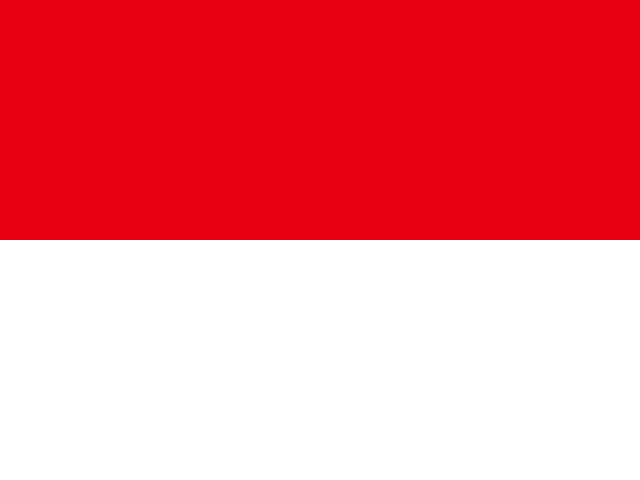
The Indonesian flag consists of two equal horizontal bands of red (top) and white (bottom). The proportion is 2:3. It was first flown on 17 August 1945, when Indonesia declared independence from the Netherlands, and was formally adopted by the constitution of 1945. The design is identical to the flag of Monaco, which uses the same red and white bands but with a 4:5 proportion.
Colors and meaning
Red represents courage, physical and spiritual strength, and the blood shed by Indonesian patriots in the struggle for independence, and white represents purity, honesty and the spiritual values of the Indonesian people. The colors are the traditional colors of the Majapahit Empire, which ruled much of the Indonesian archipelago in the 14th century.
Red
Represents courage, physical and spiritual strength, and the blood shed by Indonesian patriots in the long struggle for independence from the Netherlands, which lasted from the 17th century until 1945. Red is also associated with the human body and the physical world in Indonesian cosmology.
White
Represents purity, honesty and the spiritual values of the Indonesian people. White is associated with the human soul and the spiritual world in Indonesian cosmology.
Origin — Majapahit Empire
The red and white colors have been used in the Indonesian archipelago since at least the 13th century, when the Majapahit Empire used red-and-white banners. The colors are considered sacred to many Indonesians.
Sang Saka Merah Putih
The Indonesian flag is known as Sang Saka Merah Putih ('The Lofty Red and White'). The original flag raised on 17 August 1945, sewn by Fatmawati, the wife of President Sukarno, is preserved at the National Monument in Jakarta.
History and adoption
The Indonesian flag was first raised on 17 August 1945, when Indonesia declared independence from the Netherlands at the end of World War II. The red-and-white colors had been used by Indonesian nationalist movements since the early 20th century, notably by the Sarekat Islam and the Indonesian National Party. The flag was formally adopted by the 1945 constitution and has remained unchanged since, though its use was restricted during the Dutch attempt to re-establish control between 1945 and 1949. The design's similarity to the flag of Monaco has caused diplomatic friction, and Indonesia and Monaco have both maintained their flags unchanged.
Key facts
- Adopted
- 17 August 1945
- Proportion
- 2:3
- Designer
- Fatmawati (sewing of first flag), based on Majapahit-era colors
- Capital
- Jakarta
- Country code
- ID
- Similar flags
- Monaco, Poland, Singapore
Historical and related flags
Indonesia has used several flags during its colonial period and after independence.
- Majapahit Empire (13th–16th century): Red and white banners.
- Dutch East Indies (1800–1942): Dutch flag used during colonial rule.
- Japanese occupation (1942–1945): Japanese flag used during occupation.
- First flag raised (1945–1949): Sang Saka Merah Putih raised at independence.
- United States of Indonesia (1949–1950): Flag retained during federation period.
- Current flag (1950–present): Red and white bands used as the national flag.
Frequently asked questions
What does the flag of Indonesia look like?
The flag of Indonesia has two equal horizontal bands of red (top) and white (bottom). The proportion is 2:3.
When was the flag of Indonesia adopted?
The current flag of Indonesia was officially adopted on 17 August 1945.
What do the colors mean?
Red represents courage, physical and spiritual strength, and the blood shed by Indonesian patriots in the struggle for independence, and white represents purity, honesty and the spiritual values of the Indonesian people. The colors are the traditional colors of the Majapahit Empire, which ruled much of the Indonesian archipelago in the 14th century.
Which flags look similar to the Indonesia flag?
Monaco uses the same red-and-white horizontal bands but with a 4:5 proportion, making it closer to square. Poland uses the reverse — white on top, red on bottom. Singapore adds a crescent and stars in the upper hoist. Indonesia's 2:3 proportion distinguishes it from Monaco.

 Monaco
 Poland
 Malaysia
 Singapore
 Philippines
 Thailand