What the flag looks like
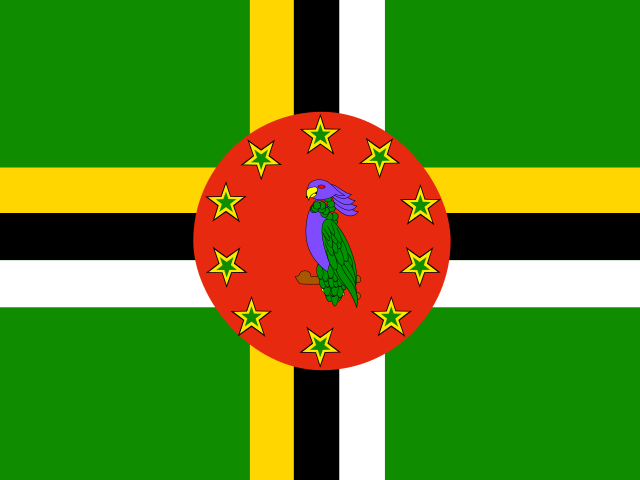
The Dominican flag consists of a green field divided by a tricolor cross — yellow, black and white stripes running horizontally and vertically — with a red disc in the center bearing a Sisserou parrot (imperial amazon) surrounded by ten green five-pointed stars. The proportion is 1:2. It was adopted on 3 November 1978, when Dominica gained independence from Britain, and has been slightly modified since — the parrot was turned to face the hoist in 1981, and the number of stars was fixed at ten in 1988.
Colors and meaning
Green represents the island's lush vegetation, yellow represents the original inhabitants of Dominica — the Kalinago (Carib) and Arawak peoples — and the country's sunshine, black represents the fertile soil and the African heritage of the people, white represents the clear rivers and waterfalls of the island, and red represents the courage of the Dominican people and social justice. The Sisserou parrot is the national bird of Dominica, and the ten green stars represent the ten parishes of the island.
Green field
Represents Dominica's lush tropical vegetation — the island is known as the 'Nature Island' of the Caribbean, with dense rainforests, waterfalls and rivers covering much of its surface.
Yellow stripe
Represents the Kalinago (Carib) and Arawak peoples, the original inhabitants of Dominica, and the sunshine that bathes the island year-round.
Black stripe
Represents the fertile soil of Dominica, which supports the island's agriculture, and the African heritage of the majority of the Dominican people.
White stripe
Represents the clear rivers and waterfalls of Dominica — the island has 365 rivers, one for every day of the year — and the purity of the country's aspirations.
Red disc
Represents the courage of the Dominican people and the country's commitment to social justice. The red disc also serves as the background for the national bird and stars.
Sisserou parrot
The Sisserou parrot (Amazona imperialis, also known as the imperial amazon) is the national bird of Dominica and one of the most endangered parrots in the world. It is found only on Dominica and appears on the national flag, coat of arms and currency. The parrot represents the country's unique wildlife and its commitment to environmental conservation.
Ten green stars
Represent the ten parishes of Dominica — Saint John, Saint Peter, Saint Joseph, Saint Paul, Saint Luke, Saint Mark, Saint Patrick, Saint David, Saint George and Saint Andrew. The stars are green, matching the field, and are outlined in gold.
History and adoption
Dominica was a British colony from 1763 until 1978, when it gained full independence on 3 November 1978 as a republic within the Commonwealth. The flag was designed by Alwin Bully, a Dominican artist, in a national competition held in preparation for independence. It was adopted on independence day and has been slightly modified twice since: in 1981, the Sisserou parrot was turned to face the hoist (left) instead of the fly (right), and in 1988, the number of stars was fixed at ten (one for each parish). The flag has otherwise remained unchanged since.
Key facts
- Adopted
- 3 November 1978
- Proportion
- 1:2
- Designer
- Alwin Bully
- Capital
- Roseau
- Country code
- DM
- Similar flags
- None
Historical and related flags
Dominica used several flags during its French and British colonial periods before independence.
- French Dominica (1715–1763): French colonial flags.
- British Dominica (1763–1958): British Blue Ensign with a colonial badge.
- West Indies Federation (1958–1962): Blue field with four white wavy stripes and a yellow sun.
- Associated state (1967–1978): British Blue Ensign with a Dominican badge.
- Current flag (1978–present): Green field with tricolor cross and Sisserou parrot.
- Presidential standard: Uses the Dominican coat of arms with a Sisserou parrot and a Kalinago canoe.
Frequently asked questions
What does the flag of Dominica look like?
The flag of Dominica is a green field divided by a tricolor cross of yellow, black and white. In the center is a red disc bearing the Sisserou parrot (the imperial amazon), surrounded by ten green stars. The proportion is 1:2.
When was the flag of Dominica adopted?
The current flag of Dominica was officially adopted on 3 November 1978.
What do the colors mean?
Green represents the island's lush vegetation, yellow represents the original inhabitants of Dominica — the Kalinago (Carib) and Arawak peoples — and the country's sunshine, black represents the fertile soil and the African heritage of the people, white represents the clear rivers and waterfalls of the island, and red represents the courage of the Dominican people and social justice. The Sisserou parrot is the national bird of Dominica, and the ten green stars represent the ten parishes of the island.
Which flags look similar to the Dominica flag?
No other national flag closely resembles Dominica's. The combination of a green field with a tricolor cross, a red central disc and a Sisserou parrot is unique.

 Saint Lucia
 Saint Vincent and the Grenadines
 Grenada
 Antigua and Barbuda
 Barbados
 Martinique