What the flag looks like
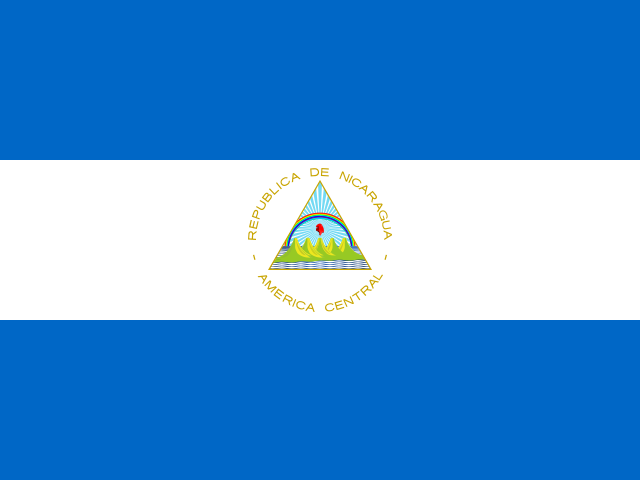
The Nicaraguan flag consists of three equal horizontal bands of blue (top), white (middle) and blue (bottom), with the Nicaraguan coat of arms centered on the white band. The proportion is 3:5. The design derives from the flag of the United Provinces of Central America and was formally standardized on 27 August 1971, though the tricolor has been in use since the 19th century.
Colors and meaning
Blue represents the Pacific Ocean and the Caribbean Sea that border Nicaragua, and the sky and justice, and white represents peace, purity and the land between the two oceans. The design and colors were inherited from the United Provinces of Central America, which Nicaragua was part of from 1823 to 1838.
Blue
Represents the two oceans that border Nicaragua — the Pacific Ocean to the west and the Caribbean Sea to the east — and the sky, justice and loyalty.
White
Represents peace, purity and the land that lies between the two oceans. White also represents the unity of the Central American nations.
Coat of arms
The Nicaraguan coat of arms features a triangle containing five volcanoes rising from a lake, a rising sun, a rainbow and a Phrygian cap of liberty. Around the triangle are the words 'República de Nicaragua' and 'América Central'.
Five volcanoes
Represent the five original provinces of the United Provinces of Central America: Guatemala, El Salvador, Honduras, Nicaragua and Costa Rica.
History and adoption
Nicaragua declared independence from Spain in 1821 and joined the United Provinces of Central America in 1823, adopting the blue-white-blue tricolor of the federation. When the federation dissolved in 1838, Nicaragua retained the tricolor as its national flag. The coat of arms has been modified several times — the current version dates from 1971, when the design was standardized. During the Sandinista period (1979–1990), the flag was used without changes. The blue-white-blue tricolor has remained in continuous use since the 19th century.
Key facts
- Adopted
- 27 August 1971
- Proportion
- 3:5
- Designer
- Based on the flag of the United Provinces of Central America
- Capital
- Managua
- Country code
- NI
- Similar flags
- Honduras, El Salvador, Guatemala, Costa Rica
Historical and related flags
Nicaragua has used several flags across its colonial, federal and independent periods.
- Spanish colonial (pre-1821): Spanish flag used during colonial rule.
- United Provinces of Central America (1823–1838): Blue-white-blue tricolor of the federation.
- Independent Nicaragua (1838–1854): Blue-white-blue tricolor with early coat of arms.
- Walker era (1855–1857): Variants including the flag of the filibuster government.
- Nicaragua (1858–1971): Blue-white-blue tricolor with evolving coat of arms.
- Current flag (1971–present): Standardized tricolor with the current coat of arms.
Frequently asked questions
What does the flag of Nicaragua look like?
The flag of Nicaragua has three equal horizontal bands of blue (top), white (middle) and blue (bottom), with the Nicaraguan coat of arms in the center of the white band. The proportion is 3:5.
When was the flag of Nicaragua adopted?
The current flag of Nicaragua was officially adopted on 27 August 1971.
What do the colors mean?
Blue represents the Pacific Ocean and the Caribbean Sea that border Nicaragua, and the sky and justice, and white represents peace, purity and the land between the two oceans. The design and colors were inherited from the United Provinces of Central America, which Nicaragua was part of from 1823 to 1838.
Which flags look similar to the Nicaragua flag?
Honduras and El Salvador use the same blue-white-blue tricolor with different coats of arms. Guatemala uses vertical blue-white-blue bands. Costa Rica adds a red center band. Nicaragua's coat of arms with the five volcanoes is unique to Nicaragua.

 Honduras
 El Salvador
 Guatemala
 Costa Rica
 Panama
 Argentina