What the flag looks like
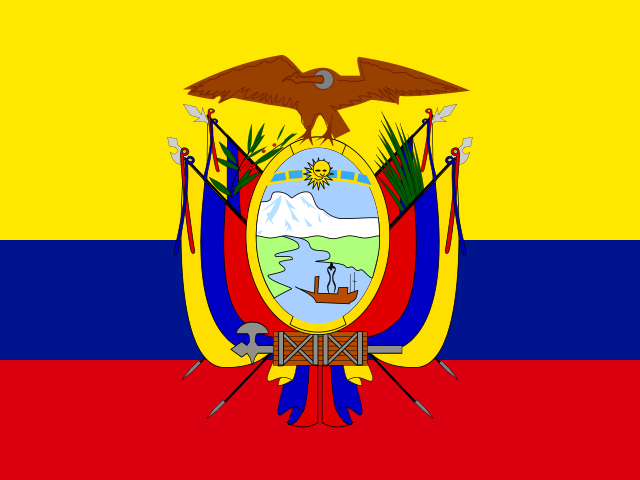
The Ecuadorian flag consists of three horizontal bands: yellow on the top half, and blue and red each on a quarter of the width. The Ecuadorian coat of arms — an oval containing a mountain, a river, a steamboat and a condor above — appears in the center. The proportion is 2:3. It was adopted on 26 September 1860, derived from the flag of Gran Colombia.
Colors and meaning
Yellow represents the gold, agriculture and mineral wealth of Ecuador, blue represents the Pacific Ocean and the clear sky, and red represents the blood shed by Ecuadorian patriots in the struggle for independence. The condor on the coat of arms represents Ecuador's power and independence.
Yellow
Represents Ecuador's gold, agriculture, mineral wealth and the sun. It occupies the top half of the flag and is the largest band.
Blue
Represents the Pacific Ocean, which borders Ecuador to the west, and the clear equatorial sky.
Red
Represents the blood shed by Ecuadorian patriots during the struggle for independence from Spain, achieved in 1822 at the Battle of Pichincha.
Condor
The Andean condor at the top of the coat of arms represents Ecuador's power, courage and independence. It is the national bird of Ecuador.
Chimborazo
The mountain in the coat of arms is Chimborazo, Ecuador's highest peak. The river represents the Guayas River, and the steamboat represents the first steamship built on the Pacific coast of South America, built in Guayaquil in 1841.
History and adoption
Ecuador's flag is derived from the flag of Gran Colombia, the union of Colombia, Venezuela, Ecuador and Panama that existed from 1819 to 1830. After Gran Colombia dissolved, Ecuador became part of New Granada for a brief period, then declared independence in 1830. The earliest Ecuadorian flag used a similar tricolor with different emblems. The current design was adopted on 26 September 1860 under President Gabriel García Moreno. The coat of arms has been modified several times, most recently in 1900, but the tricolor and general arrangement have remained unchanged since 1860.
Key facts
- Adopted
- 26 September 1860
- Proportion
- 2:3
- Designer
- Francisco de Miranda (original colors), Gabriel García Moreno (current design)
- Capital
- Quito
- Country code
- EC
- Similar flags
- Colombia, Venezuela
Historical and related flags
Ecuador has used several flags since independence, most derived from the Gran Colombia tricolor.
- Gran Colombia (1819–1830): Yellow-blue-red tricolor with equal bands.
- State of Ecuador (1830–1835): Yellow-blue-red tricolor with coat of arms.
- Republic of Ecuador (1835–1845): Variants including blue-white-red.
- Marcist Revolution (1845–1860): Blue-white tricolor.
- Current flag (1860–present): Yellow-blue-red tricolor with Ecuadorian coat of arms.
- State flag: Same with full coat of arms for government use.
Frequently asked questions
What does the flag of Ecuador look like?
The flag of Ecuador has three horizontal bands of yellow (top, half the width), blue (quarter) and red (quarter), with the Ecuadorian coat of arms in the center. The proportion is 2:3.
When was the flag of Ecuador adopted?
The current flag of Ecuador was officially adopted on 26 September 1860.
What do the colors mean?
Yellow represents the gold, agriculture and mineral wealth of Ecuador, blue represents the Pacific Ocean and the clear sky, and red represents the blood shed by Ecuadorian patriots in the struggle for independence. The condor on the coat of arms represents Ecuador's power and independence.
Which flags look similar to the Ecuador flag?
Colombia and Venezuela use the same yellow-blue-red horizontal bands. Colombia's is plain without an emblem. Venezuela's has an arc of eight white stars. Ecuador is the only one of the three with a national coat of arms in the center.

 Colombia
 Venezuela
 Peru
 Panama
 Bolivia
 Chile