What the flag looks like
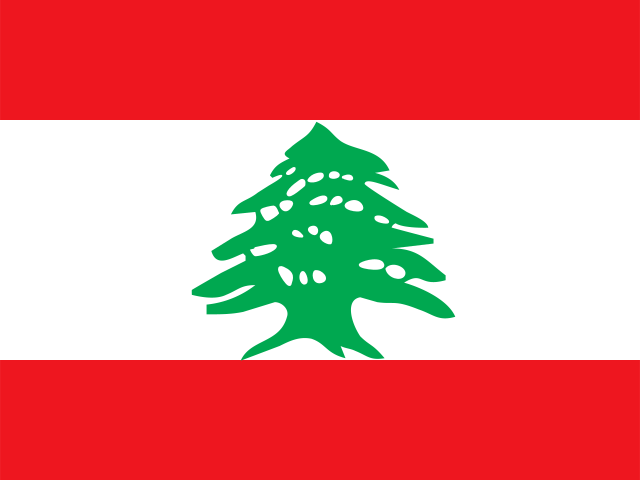
The Lebanese flag consists of three horizontal bands — a red band at the top, a wider white band in the center, and a red band at the bottom — with a green cedar tree centered on the white band. The proportion is 2:3. The flag was adopted on 7 December 1943, when Lebanon gained independence from France, and has remained unchanged since.
Colors and meaning
Red represents the blood shed for Lebanese independence and the courage of the Lebanese people, white represents peace and the snow of the Lebanese mountains, and the green cedar tree represents the country's national symbol — the Cedar of Lebanon, mentioned in the Bible and used as a symbol of strength and eternity for millennia.
Red bands
Represent the blood shed by Lebanese patriots in the struggle for independence from the Ottoman Empire and later from French mandate rule, and the courage and determination of the Lebanese people.
White band
Represents peace and the snow that covers the peaks of the Lebanon Mountains, which run the length of the country. White is also a color of purity and hope.
Cedar tree
The green cedar tree in the center is the national symbol of Lebanon — the Cedar of Lebanon (Cedrus libani), which has grown on Mount Lebanon for thousands of years. The cedar has been a symbol of strength, eternity and resilience since ancient times, and it appears in the Bible, in Mesopotamian texts and on Phoenician coins. The tree on the flag is a stylized version of the Lebanese cedar, and it appears on the country's coat of arms, currency and postage stamps.
Symbolism of the cedar
The cedar has been used as a symbol of Lebanon since the 17th century, when Maronite Christians adopted it as an emblem. It was also used on the flag of the State of Greater Lebanon under the French mandate (1920–1943). Its placement on the flag emphasizes its central role in Lebanese national identity.
History and adoption
Lebanon was part of the Ottoman Empire from 1516 until 1918, when it was captured by Allied forces during World War I. From 1920 to 1943, Lebanon was a French mandate territory, and its flag during this period was the French tricolor with a green cedar tree in the center of the white band. On 7 December 1943, Lebanon gained independence from France, and the current flag was adopted. The design was created by Henri Pharaon, a Lebanese MP, who proposed using the colors of the French flag but with the cedar tree as the central emblem. The flag has remained unchanged since, including through the Lebanese Civil War (1975–1990) and the country's subsequent political crises. There have been several proposals to change the flag to add other Lebanese symbols, but none have been adopted.
Key facts
- Adopted
- 7 December 1943
- Proportion
- 2:3
- Designer
- Henri Pharaon, with input from the Lebanese government
- Capital
- Beirut
- Country code
- LB
- Similar flags
- Austria, Peru
Historical and related flags
Lebanon has used several flags across its Ottoman, mandate and independence periods.
- Ottoman Lebanon (1516–1918): Ottoman flag used during Ottoman rule.
- French Mandate (1920–1943): French tricolor with a green cedar tree in the white band.
- First independence flag (1943): Current design adopted.
- Current flag (1943–present): Horizontal red-white-red bands with a green cedar tree.
- Presidential standard: Uses the Lebanese coat of arms with a cedar tree and two red bands.
Frequently asked questions
What does the flag of Lebanon look like?
The flag of Lebanon has three horizontal bands — red (top), white (center, twice as wide) and red (bottom) — with a green cedar tree centered on the white band. The proportion is 2:3.
When was the flag of Lebanon adopted?
The current flag of Lebanon was officially adopted on 7 December 1943.
What do the colors mean?
Red represents the blood shed for Lebanese independence and the courage of the Lebanese people, white represents peace and the snow of the Lebanese mountains, and the green cedar tree represents the country's national symbol — the Cedar of Lebanon, mentioned in the Bible and used as a symbol of strength and eternity for millennia.
Which flags look similar to the Lebanon flag?
Austria uses red-white-red horizontal bands without an emblem. Peru uses vertical red-white-red bands with a coat of arms on the state version. Lebanon's horizontal red-white-red bands with a central cedar tree is unique.

 Syria
 Israel
 Jordan
 Turkey
 Cyprus
 France