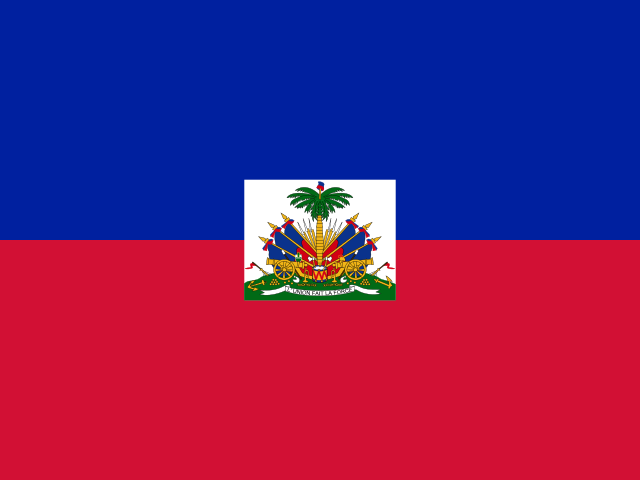
What the flag looks like
The Haitian flag consists of two equal horizontal bands of blue (top) and red (bottom), with a white rectangular panel in the center bearing the Haitian coat of arms — a palm tree topped with a Phrygian cap, flanked by rifles, flags, cannons and a drum, with the motto 'L'Union Fait la Force'. The proportion is 3:5. It was readopted on 25 February 1986, restoring the design used during Haiti's founding years.
Colors and meaning
Blue represents Haiti's African heritage and the sky, red represents the blood shed for Haitian independence, and white represents peace and unity. According to tradition, the blue and red were taken from the French tricolor by removing the white band, symbolizing the removal of white colonial rule.
Blue
Represents Haiti's African heritage, the sky over the Caribbean, and the Black population of Haiti. In some interpretations, blue also represents the Vodou spirit of the sky.
Red
Represents the blood shed by Haitian patriots in the struggle for independence — the only successful slave revolution in history, which ended French rule in 1804.
White panel
Represents peace and unity. It contains the coat of arms and contrasts with the blue and red bands.
Coat of arms
Features a palm tree topped with a Phrygian cap of liberty, flanked by rifles, Haitian flags, cannons, cannonballs and a drum, with the motto 'L'Union Fait la Force' ('Unity Makes Strength') on a ribbon. The palm tree represents independence, and the weapons represent the willingness to defend freedom.
History and adoption
Haiti declared independence from France on 1 January 1804, becoming the first Black republic in the world. According to tradition, the revolutionary leader Jean-Jacques Dessalines created the first Haitian flag by tearing the white band out of the French tricolor, leaving blue and red to represent the union of Black and mixed-race Haitians. The flag has been modified several times across Haiti's turbulent political history. From 1964 to 1986, under the Duvalier dictatorship, the flag's colors were changed to black and red. On 25 February 1986, following the fall of Jean-Claude Duvalier, the traditional blue and red flag was restored and has remained in use since.
Key facts
- Adopted
- 25 February 1986
- Proportion
- 3:5
- Designer
- Jean-Jacques Dessalines (traditional attribution), Catherine Flon (sewing)
- Capital
- Port-au-Prince
- Country code
- HT
- Similar flags
- Liechtenstein, Haiti's blue-red is similar to some other designs
Historical and related flags
Haiti has changed its flag several times across its independence, imperial and modern periods.
- First Empire (1804–1806): Blue and red bands, vertical, without emblem.
- Kingdom of Haiti (1811–1820): Red and black field.
- Republic (1820–1849): Blue and red horizontal bands with coat of arms.
- Second Empire (1849–1859): Similar design under Emperor Faustin I.
- Duvalier era (1964–1986): Black and red bands.
- Current flag (1986–present): Blue and red bands with the coat of arms restored.
Frequently asked questions
What does the flag of Haiti look like?
The flag of Haiti has two horizontal bands of blue (top) and red (bottom), with a white rectangular panel in the center bearing the Haitian coat of arms. The proportion is 3:5.
When was the flag of Haiti adopted?
The current flag of Haiti was officially adopted on 25 February 1986.
What do the colors mean?
Blue represents Haiti's African heritage and the sky, red represents the blood shed for Haitian independence, and white represents peace and unity. According to tradition, the blue and red were taken from the French tricolor by removing the white band, symbolizing the removal of white colonial rule.
Which flags look similar to the Haiti flag?
Liechtenstein uses blue and red horizontal bands with a golden crown in the canton. Haiti's blue-red with a central white panel and coat of arms is unique.

 Dominican Republic
 Cuba
 Jamaica
 France
 Liberia
 Bahamas