What the flag looks like
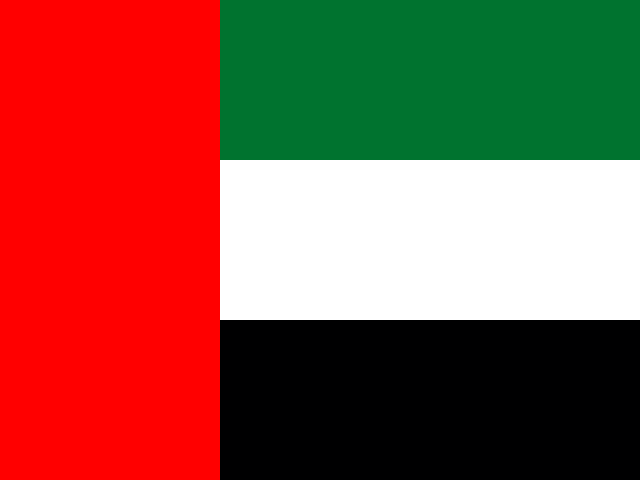
The Emirati flag consists of a vertical red band on the hoist side, and three horizontal bands on the fly side — green (top), white (middle) and black (bottom). The proportion is 1:2. It was adopted on 2 December 1971, when the United Arab Emirates was formed from seven emirates — Abu Dhabi, Dubai, Sharjah, Ajman, Umm Al Quwain, Fujairah and Ras Al Khaimah.
Colors and meaning
Green represents the country's fertile land and Islamic faith, white represents peace and purity, black represents the oil wealth and the dark years of foreign rule, and red represents the blood shed by Emirati patriots in the struggle for independence. The four colors together are the Pan-Arab colors, representing Arab unity and heritage.
Green
Represents the fertile land and agriculture of the UAE, and Islam — the country's official religion. Green is a traditional Pan-Arab color used by many Arab states.
White
Represents peace, purity and honesty. White is the middle band and stands for the desire for peaceful development.
Black
Represents the oil wealth that transformed the UAE into a modern state, and the dark years of foreign rule and conflict in Arab history. Black is also the traditional color of the Abbasid dynasty's banners.
Red hoist band
Represents the blood shed by Emirati patriots in the struggle for independence and unity. Red is a traditional color of the Arab world and appears on many Arab flags.
Pan-Arab colors
The four colors — red, green, white and black — are the Pan-Arab colors, symbolizing Arab unity, heritage and shared history. They first appeared together in the flag of the Arab Revolt during World War I.
History and adoption
The United Arab Emirates was formed on 2 December 1971, when six emirates — Abu Dhabi, Dubai, Sharjah, Ajman, Umm Al Quwain and Fujairah — united as a federation. Ras Al Khaimah joined in February 1972. The flag was designed by Abdullah Mohammed Al Maainah, a 19-year-old Emirati student, who won a national competition with over 1,000 entries. The design combines the Pan-Arab colors with a unique layout — a red hoist band and three horizontal bands on the fly. It was raised for the first time on 2 December 1971, and has remained unchanged since.
Key facts
- Adopted
- 2 December 1971
- Proportion
- 1:2
- Designer
- Abdullah Mohammed Al Maainah
- Capital
- Abu Dhabi
- Country code
- AE
- Similar flags
- Kuwait, Jordan, Palestine
Historical and related flags
The UAE was formed from seven emirates that each had their own flags before 1971.
- Trucial States (1820–1971): Individual emirates used red and white flags under British protection.
- Abu Dhabi (pre-1971): Red field with a white border.
- Dubai (pre-1971): Red and white flag.
- Current flag (1971–present): Red, green, white and black Pan-Arab design.
- Presidential standard: Uses the Emirati coat of arms with a golden falcon.
Frequently asked questions
What does the flag of United Arab Emirates look like?
The flag of the United Arab Emirates has a vertical red band on the hoist, and three horizontal bands on the fly — green (top), white (middle) and black (bottom). The proportion is 1:2.
When was the flag of United Arab Emirates adopted?
The current flag of United Arab Emirates was officially adopted on 2 December 1971.
What do the colors mean?
Green represents the country's fertile land and Islamic faith, white represents peace and purity, black represents the oil wealth and the dark years of foreign rule, and red represents the blood shed by Emirati patriots in the struggle for independence. The four colors together are the Pan-Arab colors, representing Arab unity and heritage.
Which flags look similar to the United Arab Emirates flag?
Kuwait uses green, white and red bands with a black trapezoid on the hoist. Jordan and Palestine use black, white and green bands with a red triangle on the hoist. The UAE's vertical red band with horizontal green, white and black bands is unique in its layout.

 Saudi Arabia
 Oman
 Qatar
 Kuwait
 Jordan
 Palestine