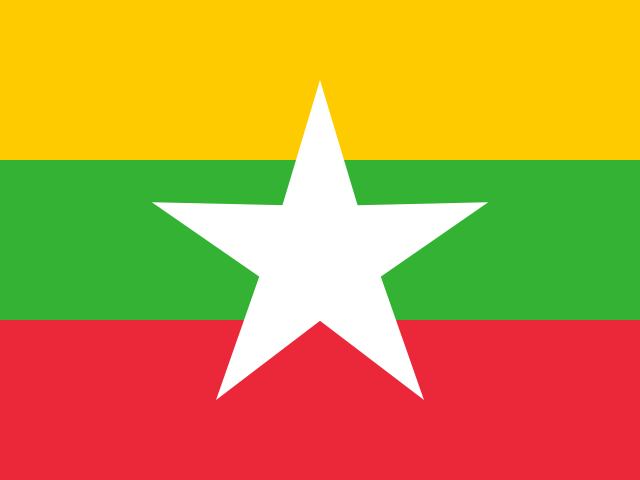
What the flag looks like
The Myanmar flag consists of three equal horizontal bands of yellow (top), green (middle) and red (bottom), with a large white five-pointed star centered on the flag. The proportion is 2:3. It was adopted on 21 October 2010, replacing the flag used since 1974. It is based on the flag used by the Japanese-sponsored State of Burma during World War II.
Colors and meaning
Yellow represents solidarity, unity and the Buddhist faith of Myanmar, green represents peace, tranquility and the country's lush vegetation, red represents courage and determination, and the white star represents the unity of the Union of Myanmar and its enduring strength.
Yellow
Represents solidarity, unity and the Buddhist faith of Myanmar. Buddhism is the dominant religion of the country and has been central to its culture for over two millennia.
Green
Represents peace, tranquility and the country's lush tropical vegetation. Myanmar has extensive forests and is one of the most biodiverse countries in Southeast Asia.
Red
Represents courage and determination — the spirit of the Myanmar people in defending their sovereignty and independence throughout history.
White star
Represents the unity of the Union of Myanmar, made up of many ethnic groups including the Bamar, Shan, Karen, Rakhine, Kachin, Chin, Mon and others. The star's single form emphasizes the country's unity under one flag.
Design origin
The design is based on the flag used by the State of Burma under Japanese occupation during World War II (1943–1945), which featured the same yellow, green and red bands with a star. The design was revived in 2010 as part of political reforms.
History and adoption
Myanmar, formerly known as Burma, was a British colony from 1886 until 1948, when it gained independence on 4 January 1948. The first national flag was a red field with a blue canton bearing a white peacock and stars. In 1974, a new flag was adopted — a red field with a blue canton bearing a rice plant and a cogwheel surrounded by 14 stars, reflecting the socialist government of Ne Win. In 2010, as part of a political transition, the current flag was adopted — replacing the socialist design with the yellow-green-red bands and a white star. It was based on the flag used by the Japanese-sponsored State of Burma during World War II. The flag has remained unchanged since 2010, despite Myanmar's continued political turmoil.
Key facts
- Adopted
- 21 October 2010
- Proportion
- 2:3
- Designer
- Based on the 1943 State of Burma flag
- Capital
- Naypyidaw
- Country code
- MM
- Similar flags
- Lithuania, Bolivia
Historical and related flags
Myanmar has used several flags across its colonial, independence and post-independence periods.
- British Burma (1886–1948): British Blue Ensign with a colonial badge featuring a peacock.
- State of Burma (1943–1945): Yellow-green-red bands with a white star, used under Japanese occupation.
- First independence flag (1948–1974): Red field with a blue canton, white peacock and stars.
- Socialist flag (1974–2010): Red field with a blue canton bearing a rice plant, cogwheel and 14 stars.
- Current flag (2010–present): Yellow, green and red bands with a white star.
Frequently asked questions
What does the flag of Myanmar look like?
The flag of Myanmar has three equal horizontal bands of yellow (top), green (middle) and red (bottom), with a large white five-pointed star in the center. The proportion is 2:3.
When was the flag of Myanmar adopted?
The current flag of Myanmar was officially adopted on 21 October 2010.
What do the colors mean?
Yellow represents solidarity, unity and the Buddhist faith of Myanmar, green represents peace, tranquility and the country's lush vegetation, red represents courage and determination, and the white star represents the unity of the Union of Myanmar and its enduring strength.
Which flags look similar to the Myanmar flag?
Lithuania uses yellow-green-red — the reverse order of Myanmar's with red on the bottom. Bolivia uses red-yellow-green without a star. Myanmar's yellow-green-red with a central white star is unique.

 Thailand
 India
 Bangladesh
 Laos
 China
 Lithuania