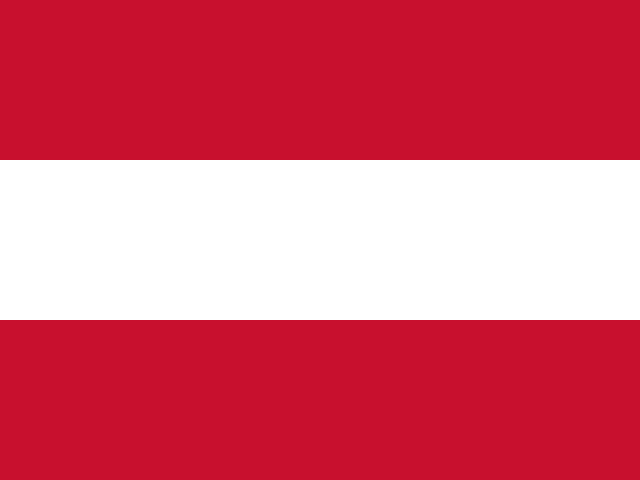
What the flag looks like
The Austrian flag consists of three equal horizontal bands of red, white and red. The proportion is 2:3. The design is one of the oldest national flags in Europe, dating back to the 13th century, and was formally readopted on 1 May 1945 after the end of World War II and the restoration of the Austrian Republic.
Colors and meaning
According to legend, the colors date back to the Siege of Acre in 1191, when Duke Leopold V of Austria's white tunic was soaked in blood except for the strip under his belt, giving rise to the red-white-red design. Red represents strength, bravery and the blood shed for Austria, and white represents peace, purity and honesty.
Red
Represents strength, bravery and the blood shed by Austrians in defense of their nation. It is also the color of the Babenberg dynasty, which ruled Austria from 976 to 1246.
White
Represents peace, purity and honesty. In the legend of the Siege of Acre, the white band is the only part of Duke Leopold V's tunic not stained by blood.
Legend of Acre
According to tradition, Duke Leopold V fought so fiercely at the Siege of Acre during the Third Crusade that his white tunic was completely soaked in blood — except for the strip covered by his belt. When he removed the belt, the red-white-red pattern was revealed, and it became the Austrian coat of arms.
History and adoption
The red-white-red design is one of the oldest national symbols in Europe, first documented in the coat of arms of the Babenberg dynasty in the 13th century. It was used by the Habsburgs and became the flag of the Austrian Empire and later Austria-Hungary. After the collapse of the empire in 1918, the First Austrian Republic adopted the red-white-red flag. After the Anschluss in 1938, Austria was absorbed into Nazi Germany and the flag was banned. It was restored on 1 May 1945, when the Second Austrian Republic was proclaimed, and formally adopted in the Austrian State Treaty of 1955.
Key facts
- Adopted
- 1 May 1945
- Proportion
- 2:3
- Designer
- Traditional — associated with Duke Leopold V
- Capital
- Vienna
- Country code
- AT
- Similar flags
- Latvia, Lebanon
Historical and related flags
Austria has used several flags across its imperial, republican and post-war periods, and today uses two official variants.
- Duchy of Austria (13th–19th century): Red-white-red coat of arms and banners.
- Austrian Empire (1804–1867): Red-white-red national flag with the imperial eagle.
- Austria-Hungary (1867–1918): Dual flags for Austria and Hungary.
- First Austrian Republic (1918–1938): Plain red-white-red tricolor.
- State flag: Adds the Austrian eagle coat of arms in the center.
- Second Austrian Republic (1945–present): Plain red-white-red tricolor readopted.
Frequently asked questions
What does the flag of Austria look like?
The flag of Austria has three equal horizontal bands of red (top), white (middle) and red (bottom). The proportion is 2:3.
When was the flag of Austria adopted?
The current flag of Austria was officially adopted on 1 May 1945.
What do the colors mean?
According to legend, the colors date back to the Siege of Acre in 1191, when Duke Leopold V of Austria's white tunic was soaked in blood except for the strip under his belt, giving rise to the red-white-red design. Red represents strength, bravery and the blood shed for Austria, and white represents peace, purity and honesty.
Which flags look similar to the Austria flag?
Latvia uses a darker red band with a narrower white stripe in the middle. Lebanon uses red-white-red with a green cedar tree in the center. Austria's plain red-white-red is unique.

 Germany
 Switzerland
 Hungary
 Italy
 Latvia
 Czechia