What the flag looks like
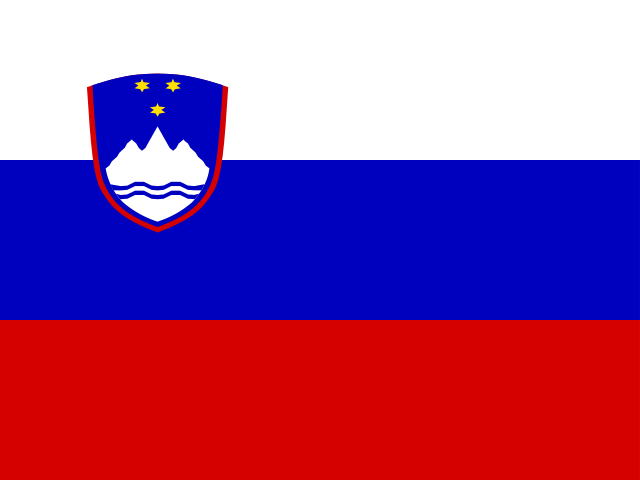
The Slovenian flag consists of three equal horizontal bands of white (top), blue (middle) and red (bottom), with the Slovenian coat of arms positioned in the upper hoist quarter between the white and blue bands. The coat of arms features Mount Triglav in white on a blue field, with three golden six-pointed stars above and two wavy blue lines below. The proportion is 1:2.
Colors and meaning
White, blue and red are the Pan-Slavic colors adopted by Slovenia in the 19th century. White represents peace and purity, blue represents the Adriatic Sea and Slovenia's rivers, and red represents the blood shed for Slovenian independence. The coat of arms features Mount Triglav, the highest peak in Slovenia, and three golden stars from the coat of arms of the Counts of Celje.
White
Represents peace, purity and honesty. It is the top band and background color of the coat of arms.
Blue
Represents the Adriatic Sea, Slovenia's rivers and lakes, and the sky. It is one of the three Pan-Slavic colors.
Red
Represents the blood shed for Slovenian independence and the courage of the Slovenian people.
Mount Triglav
The highest mountain in Slovenia (2,864 m), depicted in white on the coat of arms. It is Slovenia's most recognizable national symbol.
Three golden stars
Taken from the coat of arms of the Counts of Celje, a powerful medieval noble family from Slovenian territory. They represent Slovenian historical heritage.
Two wavy lines
Represent the Adriatic Sea and Slovenia's rivers — the Sava, Drava and Mura.
History and adoption
The white-blue-red tricolor was first used as a Slovenian national symbol during the Spring of Nations in 1848, inspired by Pan-Slavic colors. It was used by Slovene nationalists throughout the 19th and early 20th centuries, and during the brief State of Slovenes, Croats and Serbs in 1918. Under Yugoslavia, Slovenia used the Yugoslav flag with a red star, though the tricolor remained a symbol of Slovenian identity. After Slovenia declared independence on 25 June 1991, the current flag was adopted, adding the Slovenian coat of arms designed by Marko Pogačnik. The proportions were formalized in 1994.
Key facts
- Adopted
- 25 June 1991
- Proportion
- 1:2
- Designer
- Marko Pogačnik (coat of arms)
- Capital
- Ljubljana
- Country code
- SI
- Similar flags
- Slovakia, Serbia, Russia
Historical and related flags
Slovenia has used several flags across its Habsburg, Yugoslav and modern periods.
- Habsburg rule (pre-1918): Duchy of Carniola used a white-blue-red flag with an eagle.
- State of Slovenes, Croats and Serbs (1918): White-blue-red tricolor used briefly.
- SR Slovenia (1945–1991): Yugoslav tricolor with a red star and a small Slovenian emblem.
- Current flag (1991–present): Tricolor with the Triglav coat of arms.
- Naval ensign: Adds an anchor and a red border for Slovenian Navy vessels.
Frequently asked questions
What does the flag of Slovenia look like?
The flag of Slovenia has three equal horizontal bands of white (top), blue (middle) and red (bottom), with the Slovenian coat of arms in the upper hoist side. The proportion is 1:2.
When was the flag of Slovenia adopted?
The current flag of Slovenia was officially adopted on 25 June 1991.
What do the colors mean?
White, blue and red are the Pan-Slavic colors adopted by Slovenia in the 19th century. White represents peace and purity, blue represents the Adriatic Sea and Slovenia's rivers, and red represents the blood shed for Slovenian independence. The coat of arms features Mount Triglav, the highest peak in Slovenia, and three golden stars from the coat of arms of the Counts of Celje.
Which flags look similar to the Slovenia flag?
Slovakia uses white-blue-red with a double cross on three hills. Serbia uses red-blue-white with a double-headed eagle. Russia uses white-blue-red without any emblem. Slovenia's Mount Triglav coat of arms is unique.

 Croatia
 Slovakia
 Serbia
 Italy
 Austria
 Hungary