What the flag looks like
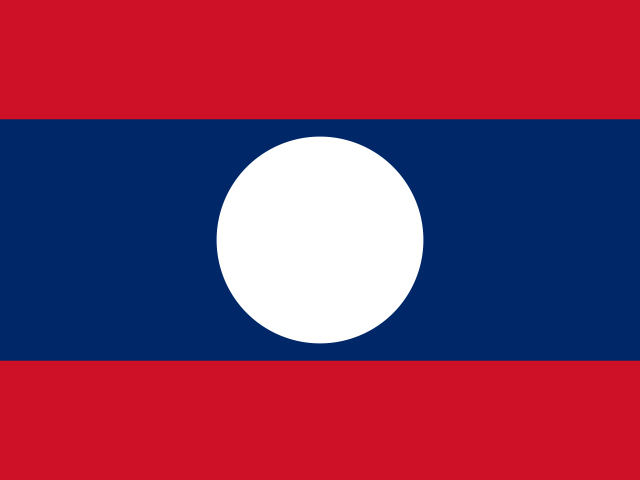
The Laotian flag consists of three horizontal bands — red on the top and bottom, and a wider blue band in the center — with a white circle centered on the blue band. The proportion is 2:3. It was adopted on 2 December 1975, when the Pathet Lao established the Lao People's Democratic Republic, ending the Kingdom of Laos.
Colors and meaning
Red represents the blood shed by the Lao people in their struggle for independence and freedom, blue represents the Mekong River and the country's wealth, and the white circle represents the full moon and the unity of the Lao people under the leadership of the Lao People's Revolutionary Party.
Red
Represents the blood shed by the Lao people in their long struggle for independence and freedom — first against French colonial rule and later during the conflicts that led to the establishment of the Lao People's Democratic Republic in 1975.
Blue
Represents the Mekong River, which forms the western border of Laos with Thailand, and the country's natural wealth. Blue also symbolizes the country's potential for development.
White circle
Represents the full moon — a traditional symbol of unity and calm — and the unity of the Lao people under the leadership of the Lao People's Revolutionary Party. It also represents the bright future of the Lao nation.
Design origin
The flag was originally designed by the Lao Issara (Free Laos) resistance movement during World War II, and was used by the Pathet Lao during their struggle against the Royal Lao government. It was adopted as the national flag on 2 December 1975, when the Pathet Lao took power.
History and adoption
Laos was a French protectorate from 1893 until 1953, when it gained full independence as the Kingdom of Laos. During World War II, the Lao Issara resistance movement designed the current flag as a symbol of Lao nationalism. After independence, the Kingdom of Laos used a different flag — a red field with a three-headed elephant (the royal emblem of the Kingdom of Lan Xang) under a parasol. The Pathet Lao communist movement used the current design during the Laotian Civil War (1959–1975). On 2 December 1975, the Pathet Lao established the Lao People's Democratic Republic and adopted the current flag. It has remained unchanged since.
Key facts
- Adopted
- 2 December 1975
- Proportion
- 2:3
- Designer
- Lao Issara resistance movement (WWII)
- Capital
- Vientiane
- Country code
- LA
- Similar flags
- None
Historical and related flags
Laos has used several flags across its colonial, monarchic and revolutionary periods.
- French Laos (1893–1953): French flag used during colonial rule.
- Kingdom of Laos (1953–1975): Red field with a three-headed elephant under a parasol.
- Pathet Lao (1950s–1975): Current design used during the civil war.
- Current flag (1975–present): Red, blue and white with a central circle.
- Presidential standard: Uses the Lao coat of arms with a stupa and other symbols.
Frequently asked questions
What does the flag of Laos look like?
The flag of Laos has three horizontal bands — red on the top and bottom, and blue in the center (twice as wide) — with a white circle in the center of the blue band. The proportion is 2:3.
When was the flag of Laos adopted?
The current flag of Laos was officially adopted on 2 December 1975.
What do the colors mean?
Red represents the blood shed by the Lao people in their struggle for independence and freedom, blue represents the Mekong River and the country's wealth, and the white circle represents the full moon and the unity of the Lao people under the leadership of the Lao People's Revolutionary Party.
Which flags look similar to the Laos flag?
No other national flag closely resembles Laos's. The combination of red and blue bands with a central white circle is unique, though it resembles the flag of the Kurdish region of Iraq and the flag of the short-lived Republic of South Vietnam is sometimes confused with it.

 Vietnam
 Cambodia
 Thailand
 Myanmar
 China
 Cuba