What the flag looks like
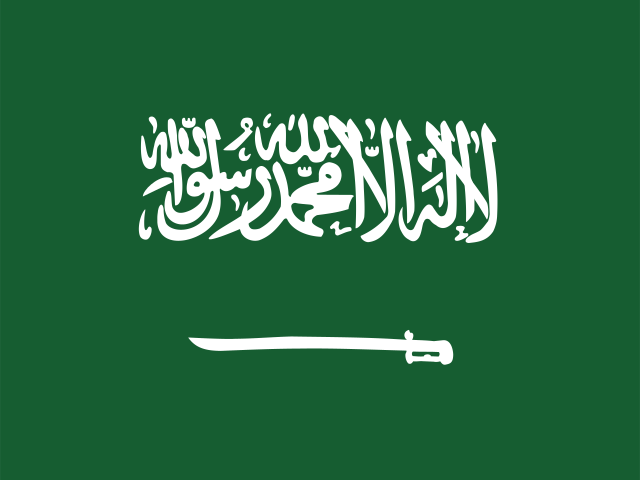
The Saudi flag consists of a green field with the shahada (the Islamic declaration of faith) written in white Arabic calligraphy, and a white horizontal sword below it. The shahada reads 'لَا إِلٰهَ إِلَّا الله مُحَمَّدٌ رَسُولُ الله' — 'There is no god but God; Muhammad is the messenger of God'. The sword represents justice and the defense of the faith. The proportion is 2:3. The design was standardized on 15 March 1973.
Colors and meaning
Green is the traditional color of Islam and represents the faith of the Saudi people, and white represents purity and peace. The shahada declares the oneness of God and the prophethood of Muhammad, and the sword represents the strict application of justice and the defense of Islam.
Green
The traditional color of Islam, associated with the Prophet Muhammad and paradise in Islamic tradition. Green is also the color of the first Saudi state, established in 1744, and has been used on Saudi banners for centuries.
White shahada
The shahada is the Islamic declaration of faith — 'There is no god but God; Muhammad is the messenger of God'. It is the first of the Five Pillars of Islam and represents the central belief of the Saudi state and people.
White sword
Represents justice, strength and the defense of the Islamic faith. The sword is horizontal, with its point facing the shahada (toward the hoist). The design is a modern addition, replacing an earlier curved sword.
Double-sided design
The flag is manufactured with the shahada reading correctly from both sides — a technically demanding production requirement, since the text must be legible when viewed from the front and the back.
History and adoption
The first Saudi state was established in 1744 in Diriyah and used a green banner with the shahada. The second Saudi state and the modern Kingdom of Saudi Arabia continued to use similar green flags. When King Abdulaziz Al Saud unified the kingdom in 1932, the flag was standardized as a green field with the shahada and a sword. The sword was originally curved; in 1973, it was changed to a straight horizontal sword, and the shahada was enlarged and redesigned with modern calligraphy. The design has remained unchanged since 1973. The flag is never flown at half-mast, as it bears the shahada, and its use is strictly regulated by Saudi law.
Key facts
- Adopted
- 15 March 1973
- Proportion
- 2:3
- Designer
- Hafez Wahba (design), standardized by the Saudi government
- Capital
- Riyadh
- Country code
- SA
- Similar flags
- None
Historical and related flags
Saudi Arabia has used several flags across its first, second and modern state periods.
- First Saudi State (1744–1818): Green banner with the shahada.
- Second Saudi State (1824–1891): Green banner with the shahada and additional elements.
- Emirate of Riyadh (1902–1932): Green field with the shahada and a curved sword.
- Kingdom of Saudi Arabia (1932–1973): Green field with the shahada and a curved sword.
- Current flag (1973–present): Green field with the shahada and a straight horizontal sword.
- Royal standard: Uses the Saudi coat of arms with a palm tree and crossed swords.
Frequently asked questions
What does the flag of Saudi Arabia look like?
The flag of Saudi Arabia is a green field bearing the shahada — the Islamic declaration of faith — in white Arabic script, with a white horizontal sword below it. The proportion is 2:3.
When was the flag of Saudi Arabia adopted?
The current flag of Saudi Arabia was officially adopted on 15 March 1973.
What do the colors mean?
Green is the traditional color of Islam and represents the faith of the Saudi people, and white represents purity and peace. The shahada declares the oneness of God and the prophethood of Muhammad, and the sword represents the strict application of justice and the defense of Islam.
Which flags look similar to the Saudi Arabia flag?
No other national flag closely resembles Saudi Arabia's. The combination of a green field with the shahada and a horizontal sword is unique.

 Yemen
 Oman
 United Arab Emirates
 Qatar
 Jordan
 Kuwait