What the flag looks like
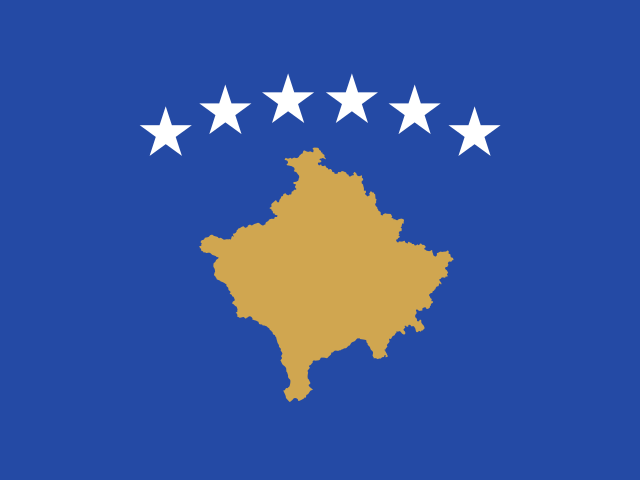
The Kosovar flag consists of a blue field with a golden-yellow silhouette of the country's territory in the center, with an arc of six white five-pointed stars above it. The proportion is 2:3. It was adopted on 17 February 2008, the day Kosovo declared independence from Serbia.
Colors and meaning
Blue represents the sky and the country's aspiration to join the European Union and NATO, gold represents the country's territory and mineral wealth, and the six white stars represent the six ethnic communities of Kosovo — Albanians, Serbs, Turks, Gorani, Roma and Bosniaks.
Blue field
Represents the sky over Kosovo and the country's aspiration to join the European Union and NATO. Blue is also the dominant color of the European Union flag, emphasizing Kosovo's European orientation.
Golden map
The golden-yellow silhouette of the country represents the territory of Kosovo and its unity as a sovereign state. Gold is also a traditional color of wealth and prosperity, and Kosovo has significant mineral resources including lignite, lead, zinc and gold.
Six white stars
Represent the six ethnic communities of Kosovo — the Albanian majority, Serbs, Turks, Gorani, Roma and Bosniaks. The stars are arranged in an arc above the country's silhouette, emphasizing the unity of all communities within the state. In the original design, the six stars represented the six ethnic communities officially recognized by the Kosovar constitution.
Design origin
The flag was designed by Muhamer Ibrahimi and was chosen from a competition that received nearly 1,000 entries. It was adopted on 17 February 2008, the day Kosovo declared independence. The design deliberately avoids the red and black of the Albanian flag and the red, blue and white of the Serbian flag, to appear neutral and inclusive of all ethnic communities.
History and adoption
Kosovo was an autonomous province within Serbia from 1945 until 1989, when Serbia revoked its autonomy. Throughout the 1990s, Kosovar Albanians sought greater autonomy and eventually independence, leading to the Kosovo War (1998–1999) and NATO intervention. After the war, Kosovo was administered by the United Nations under UN Security Council Resolution 1244. On 17 February 2008, Kosovo declared independence from Serbia and adopted the current flag. The flag was designed by Muhamer Ibrahimi and chosen from a national competition. It has been recognized by over 100 UN member states, though Serbia continues to claim Kosovo as its territory, and the flag is not universally recognized.
Key facts
- Adopted
- 17 February 2008
- Proportion
- 2:3
- Designer
- Muhamer Ibrahimi
- Capital
- Pristina
- Country code
- XK
- Similar flags
- None
Historical and related flags
Kosovo has used several flags across its Yugoslav, UN-administered and independence periods.
- Yugoslav Kosovo (1945–1990): Yugoslav flag with a red star and Kosovar emblem.
- Parallel Albanian institutions (1990–1999): Albanian flag used by Kosovar Albanian institutions.
- UNMIK period (1999–2008): United Nations flag and UNMIK symbols used.
- Current flag (2008–present): Blue field with golden map and six white stars.
- Northern Kosovo (Serb-majority): Serbian flag used by Serb-majority communities.
Frequently asked questions
What does the flag of Kosovo look like?
The flag of Kosovo is a blue field with a golden-yellow silhouette of the country in the center, surmounted by an arc of six white five-pointed stars. The proportion is 2:3.
When was the flag of Kosovo adopted?
The current flag of Kosovo was officially adopted on 17 February 2008.
What do the colors mean?
Blue represents the sky and the country's aspiration to join the European Union and NATO, gold represents the country's territory and mineral wealth, and the six white stars represent the six ethnic communities of Kosovo — Albanians, Serbs, Turks, Gorani, Roma and Bosniaks.
Which flags look similar to the Kosovo flag?
No other national flag closely resembles Kosovo's. The combination of a blue field with a golden map and six white stars is unique.

 Albania
 Serbia
 North Macedonia
 Montenegro
 Bosnia and Herzegovina
 European Union