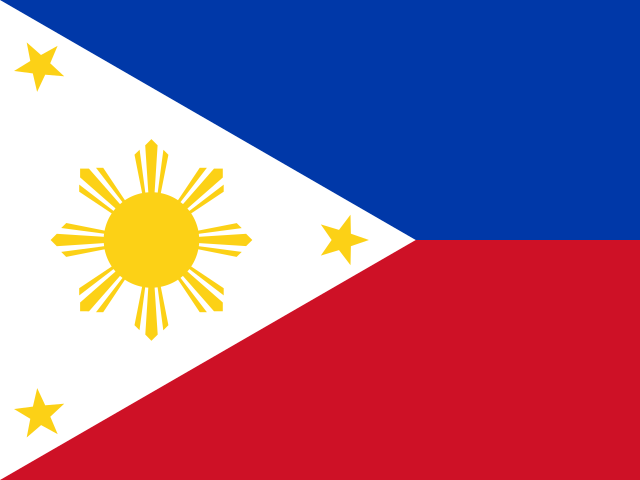
What the flag looks like
The Philippine flag consists of two horizontal bands of blue (top) and red (bottom), with a white equilateral triangle at the hoist. Inside the triangle are a golden sun with eight rays and three golden five-pointed stars in each corner. The proportion is 1:2. The design was adopted on 12 June 1898, when the Philippines declared independence from Spain, and the current version was standardized in 1998.
Colors and meaning
Blue represents peace, truth, justice and the sky, red represents patriotism, valor and the blood shed for independence, white represents equality, fraternity and purity, the golden sun represents liberty and the eight provinces that revolted against Spanish rule, and the three stars represent the three main island groups of the Philippines — Luzon, Visayas and Mindanao.
Blue
Represents peace, truth, justice and the sky over the Philippine archipelago. In peacetime, blue is placed on top of the flag.
Red
Represents patriotism, valor, courage and the blood shed by Filipino patriots in the struggle for independence — first against Spain and later against the United States and Japan.
White triangle
Represents equality, fraternity and purity — ideals drawn from the French Revolution and the Katipunan movement, which sought independence from Spanish colonial rule.
Golden sun
Represents liberty and independence. The eight rays of the sun represent the eight provinces that were placed under martial law by the Spanish colonial government during the Philippine Revolution of 1896: Manila, Cavite, Bulacan, Pampanga, Nueva Ecija, Tarlac, Laguna and Batangas.
Three stars
Represent the three main island groups of the Philippines — Luzon, Visayas and Mindanao — and the unity of the Filipino people.
War flag
When the Philippines is at war, the flag is flown with red on top and blue on the bottom — reversing the peacetime arrangement. This makes the Philippine flag unique among national flags for its wartime reversal.
History and adoption
The Philippine flag was designed by General Emilio Aguinaldo, the first president of the Philippines, and was first raised on 12 June 1898, when the Philippines declared independence from Spain. The design was based on the flag of the Katipunan, the revolutionary society that had fought against Spanish rule since 1896. During the Philippine–American War (1899–1902), the flag was banned by the American colonial government. It was reauthorized in 1919 and became the national flag when the Philippines became a Commonwealth in 1935. During the Japanese occupation (1942–1945), the flag was used by the Philippine Commonwealth government-in-exile. The current proportions and design were standardized in 1998 with the passage of Republic Act No. 8491. The flag has remained unchanged since.
Key facts
- Adopted
- 12 June 1898
- Proportion
- 1:2
- Designer
- Emilio Aguinaldo (design), Marcela Agoncillo (sewing)
- Capital
- Manila
- Country code
- PH
- Similar flags
- Czechia, Cuba, Puerto Rico
Historical and related flags
The Philippines has used several flags across its Spanish, American, Japanese and post-independence periods.
- Spanish Philippines (1565–1898): Spanish flag used during colonial rule.
- First Philippine Republic (1898–1901): Current design adopted.
- American colonial period (1901–1935): American flag used, Philippine flag banned until 1919.
- Commonwealth of the Philippines (1935–1946): Philippine flag restored with slightly different shades.
- Japanese occupation (1942–1945): Japanese flag used, Philippine flag used by resistance.
- Third Republic (1946–1985): Philippine flag with different shades of blue and red.
- Current flag (1998–present): Standardized shades and proportions.
Frequently asked questions
What does the flag of Philippines look like?
The flag of the Philippines has two horizontal bands of blue (top) and red (bottom), with a white equilateral triangle at the hoist bearing a golden sun with eight rays and three golden five-pointed stars. The proportion is 1:2. In times of war, the flag is flown with red on top.
When was the flag of Philippines adopted?
The current flag of Philippines was officially adopted on 12 June 1898.
What do the colors mean?
Blue represents peace, truth, justice and the sky, red represents patriotism, valor and the blood shed for independence, white represents equality, fraternity and purity, the golden sun represents liberty and the eight provinces that revolted against Spanish rule, and the three stars represent the three main island groups of the Philippines — Luzon, Visayas and Mindanao.
Which flags look similar to the Philippines flag?
Czechia uses blue, white and red with a hoist triangle. Cuba and Puerto Rico use blue and white stripes with red triangles. The Philippines' blue-red bands with a white triangle bearing a sun and three stars is unique.

 Indonesia
 Malaysia
 Thailand
 Vietnam
 Cuba
 Puerto Rico