What the flag looks like
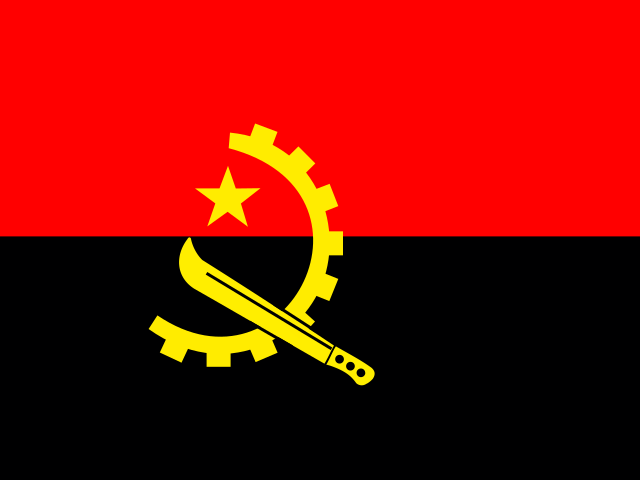
The flag of Angola consists of two equal horizontal bands of red (top) and black (bottom), with a yellow emblem in the center composed of a machete and a half gear wheel crossed, surmounted by a yellow five-pointed star. The proportion is 2:3. It was adopted on 11 November 1975, when Angola gained independence from Portugal, and has remained unchanged since.
Colors and meaning
Red represents the blood shed by Angolans during the long struggle for independence and the sacrifices of the Angolan people, black represents the African continent and the African people of Angola, and yellow represents the country's mineral wealth. The machete represents agricultural workers and armed struggle, the gear wheel represents industrial workers and the alliance of workers and peasants, and the star represents international solidarity and progress.
Red
Represents the blood shed by Angolans during the long struggle for independence from Portugal and the sacrifices of the Angolan people, including the long civil war that followed independence.
Black
Represents the African continent and the African people of Angola. Black is a Pan-African color used by many African independence movements.
Yellow
Represents Angola's mineral wealth, including oil, diamonds, iron and gold. Yellow is used for the central emblem.
Machete
Represents agricultural workers and the armed struggle for independence.
Half gear wheel
Represents industrial workers and the alliance of workers and peasants that formed the basis of the Angolan revolution.
Five-pointed star
Represents international solidarity and progress — a symbol drawn from the socialist and communist movements that supported Angola's independence struggle.
History and adoption
Angola was a Portuguese colony from the 16th century until 1975, when it gained independence on 11 November 1975 after a long liberation war led by the MPLA (Popular Movement for the Liberation of Angola). The flag was adopted on independence day and is based on the flag used by the MPLA during the liberation struggle, which featured the same red and black bands and yellow emblem. The design has remained unchanged since, even after Angola transitioned from a Marxist-Leninist one-party state to a multi-party democracy in the 1990s. The flag is celebrated every 11 November as Angolan Independence Day.
Key facts
- Adopted
- 11 November 1975
- Proportion
- 2:3
- Designer
- Based on the MPLA liberation movement flag
- Capital
- Luanda
- Country code
- AO
- Similar flags
- None
Historical and related flags
Angola used several flags during its colonial period and has had proposals for new designs since independence.
- Portuguese Angola (1575–1975): Portuguese flag used during colonial rule.
- MPLA flag (1956–1975): Red and black bands with yellow machete and gear, used during liberation struggle.
- Current flag (1975–present): Red and black bands with yellow emblem.
- Proposed 2003 flag: A design with red, white and red bands and a golden sun, rejected by parliament.
- Presidential standard: Uses the Angolan coat of arms — a machete and hoe crossed with a rising sun.
Frequently asked questions
What does the flag of Angola look like?
The flag of Angola has two equal horizontal bands of red (top) and black (bottom), with a yellow emblem in the center — a machete crossed with a half gear wheel, topped by a five-pointed star. The proportion is 2:3.
When was the flag of Angola adopted?
The current flag of Angola was officially adopted on 11 November 1975.
What do the colors mean?
Red represents the blood shed by Angolans during the long struggle for independence and the sacrifices of the Angolan people, black represents the African continent and the African people of Angola, and yellow represents the country's mineral wealth. The machete represents agricultural workers and armed struggle, the gear wheel represents industrial workers and the alliance of workers and peasants, and the star represents international solidarity and progress.
Which flags look similar to the Angola flag?
No other national flag closely resembles Angola's. The combination of red and black bands with a yellow machete and gear wheel emblem is unique.

 DR Congo
 Republic of the Congo
 Namibia
 Zambia
 Mozambique
 Portugal