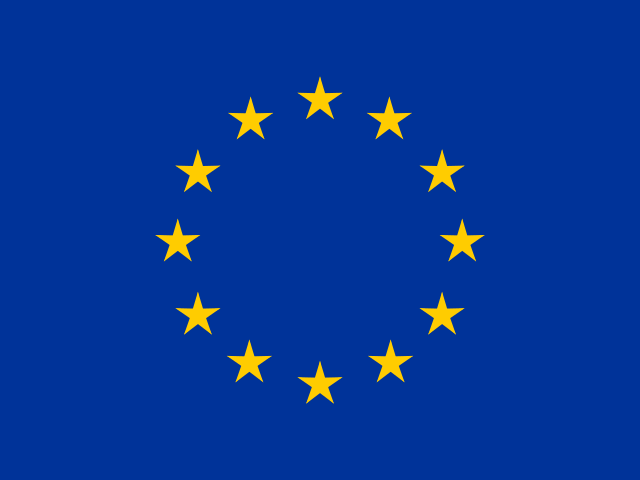
What the flag looks like
The European Union flag consists of a blue field with a circle of twelve golden-yellow five-pointed stars, with the stars arranged in a circle at equal intervals like the hours on a clock face. The number of stars is fixed at twelve and does not change with the number of member states. The proportion is 2:3. The design was adopted by the Council of Europe on 8 December 1955 and later adopted by the European Communities (now the European Union) in 1986.
Colors and meaning
The blue field represents the sky over Europe and the shared values of the European peoples, and the twelve golden stars represent the ideals of unity, solidarity and harmony among the peoples of Europe. The number twelve is fixed and symbolizes completeness and perfection — it does not represent any specific number of member states.
Blue field
Represents the sky over Europe and the shared values of the European peoples. The blue color is often associated with the West and, in a broader sense, with peace, stability and the ideals of European integration.
Twelve golden stars
Represent the ideals of unity, solidarity and harmony among the peoples of Europe. The number twelve is deliberately fixed and does not change with the number of EU member states — it was chosen because twelve is a traditional symbol of completeness and perfection (twelve months in a year, twelve hours on a clock, twelve signs of the zodiac, twelve apostles).
Circle of stars
The stars form a circle, representing the unity of the European peoples. The circle also evokes a crown or a halo, in a symbolic reference to the Virgin Mary — an association that was deliberately downplayed when the flag was adopted by the European Communities, to make the design more inclusive of non-Christian Europeans.
Design origin
The design was created by Arsène Heitz, a French designer who worked for the Council of Europe, and was adopted by the Council of Europe on 8 December 1955. The design was chosen from over 100 proposals, and the twelve-star circle was selected after some debate about whether the number should correspond to the number of member states (which was then more than twelve). The Council of Europe decided on the fixed number twelve to avoid any implication of exclusion. In 1986, the European Communities (later the European Union) adopted the same flag as its own, and it has been used by both organizations since.
History and adoption
The flag was designed in 1955 by Arsène Heitz for the Council of Europe — an organization founded in 1949 to promote cooperation and human rights across the continent. It was adopted by the Council of Europe on 8 December 1955, and first raised in Strasbourg on 13 December 1955. For three decades, the flag was used only by the Council of Europe. In 1986, the European Communities (the precursor to the European Union) adopted the same design as its own flag, and it was raised for the first time at the Berlaymont building in Brussels on 29 May 1986. The flag has been used by the European Union since its formal establishment in 1993 and has remained unchanged since.
Key facts
- Adopted
- 8 December 1955 (Council of Europe); 1986 (European Communities)
- Proportion
- 2:3
- Designer
- Arsène Heitz and Paul M. G. Lévy
- Capital
- Brussels (de facto)
- Country code
- EU
- Similar flags
- None
Historical and related flags
The European Union flag has been used by multiple European organizations since its adoption in 1955, and several related flags exist.
- Council of Europe (1955–present): The original design adopted on 8 December 1955.
- European Communities (1986–1993): Same design adopted by the EEC, ECSC and Euratom.
- European Union (1993–present): Same design adopted by the EU.
- Flag of the Western European Union (1993–2011): A variant design used by the WEU, which was dissolved in 2011.
- Flag of the Council of Europe (1955–present): Same design, still used by the Council of Europe separately from the EU.
Frequently asked questions
What does the flag of European Union look like?
The flag of the European Union is a blue field with a circle of twelve golden-yellow five-pointed stars. The proportion is 2:3.
When was the flag of European Union adopted?
The current flag of European Union was officially adopted on 8 December 1955 (Council of Europe); 1986 (European Communities).
What do the colors mean?
The blue field represents the sky over Europe and the shared values of the European peoples, and the twelve golden stars represent the ideals of unity, solidarity and harmony among the peoples of Europe. The number twelve is fixed and symbolizes completeness and perfection — it does not represent any specific number of member states.
Which flags look similar to the European Union flag?
No other national or supranational flag closely resembles the European Union's. The combination of a blue field with a circle of twelve golden stars is unique, though the design has inspired the flags of several European and international organizations.

 Germany
 France
 Italy
 Spain
 Netherlands
 Portugal