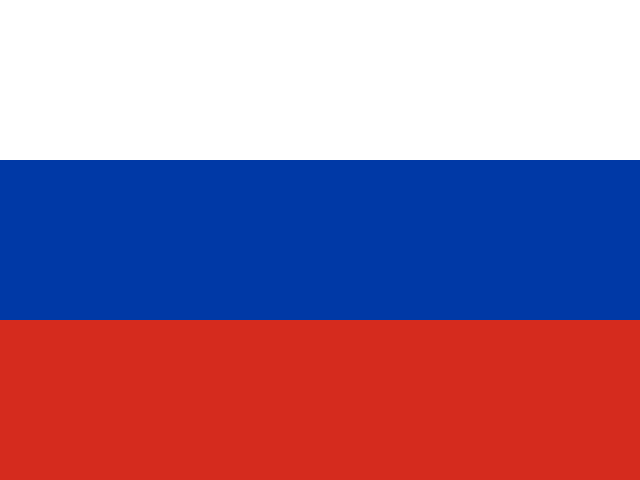
What the flag looks like
The Russian flag consists of three equal horizontal bands of white (top), blue (middle) and red (bottom). The proportion is 2:3. The design dates back to the late 17th century, when Peter the Great introduced it for Russian merchant ships, and it has been the national flag of Russia since 1991, formally adopted on 11 December 1993.
Colors and meaning
White represents nobility, frankness and peace, blue represents honesty, loyalty and chastity, and red represents courage, generosity and love. The colors have been used in Russian flags since the 17th century and were adopted by Peter the Great for merchant ships.
White
Represents nobility, frankness, peace and purity. In some interpretations, it represents God the Father.
Blue
Represents honesty, loyalty, chastity and the Virgin Mary. In some interpretations, it represents God the Son.
Red
Represents courage, generosity, love and the Russian people. In some interpretations, it represents the Holy Spirit.
Origin
The colors are believed to come from the Dutch flag, which Peter the Great studied during his visit to the Netherlands in 1697. He adopted a similar tricolor for Russian merchant ships.
History and adoption
The Russian tricolor was introduced by Peter the Great in the late 17th century for Russian merchant ships, modeled on the Dutch flag. It was used intermittently until 1883, when it became the official flag of the Russian Empire, replacing the black-yellow-white imperial flag. After the 1917 revolution, the Soviet Union adopted a red flag with a hammer and sickle, which was used until 1991. The white-blue-red tricolor was restored on 22 August 1991, shortly before the dissolution of the USSR, and formally adopted on 11 December 1993.
Key facts
- Adopted
- 11 December 1993
- Proportion
- 2:3
- Designer
- Peter the Great (traditional attribution)
- Capital
- Moscow
- Country code
- RU
- Similar flags
- Netherlands, Luxembourg, Yugoslavia, Slovakia, Slovenia
Historical and related flags
Russia has used several national flags across its imperial, Soviet and post-Soviet periods.
- Tsardom of Russia (1668–1721): First tricolor used for merchant ships.
- Russian Empire (1858–1896): Black-yellow-white imperial flag.
- Russian Empire (1896–1917): White-blue-red tricolor restored.
- Soviet Russia (1917–1922): Plain red flag.
- Soviet Union (1923–1991): Red flag with hammer, sickle and star.
- Russian Federation (1993–present): White-blue-red tricolor restored.
Frequently asked questions
What does the flag of Russia look like?
The flag of Russia has three equal horizontal bands of white (top), blue (middle) and red (bottom).
When was the flag of Russia adopted?
The current flag of Russia was officially adopted on 11 December 1993.
What do the colors mean?
White represents nobility, frankness and peace, blue represents honesty, loyalty and chastity, and red represents courage, generosity and love. The colors have been used in Russian flags since the 17th century and were adopted by Peter the Great for merchant ships.
Which flags look similar to the Russia flag?
The Netherlands and Luxembourg use a similar horizontal tricolor but with different colors and proportions. Slovakia and Slovenia include coats of arms. Russia's tricolor is the same design as the Netherlands' but with different proportions and shades.

 Netherlands
 Slovakia
 Slovenia
 Ukraine
 Belarus
 Kazakhstan