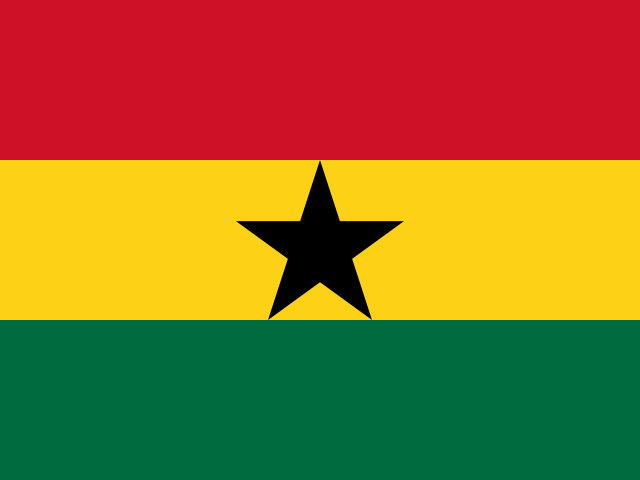
What the flag looks like
The Ghanaian flag consists of three equal horizontal bands of red (top), gold (middle) and green (bottom), with a black five-pointed star centered on the gold band. The proportion is 2:3. It was adopted on 6 March 1957, when Ghana became the first sub-Saharan African country to gain independence from European colonial rule.
Colors and meaning
Red represents the blood shed for Ghanaian independence, gold represents the country's mineral wealth, green represents its forests and agricultural wealth, and the black star represents African emancipation and the unity of the African people.
Red
Represents the blood shed by Ghanaian patriots in the struggle for independence, and the courage and sacrifice of those who fought for a free Ghana.
Gold
Represents Ghana's mineral wealth, particularly its gold reserves. Ghana was known as the Gold Coast during the colonial period, and gold has been central to the region's economy for centuries.
Green
Represents Ghana's forests, agricultural wealth and natural environment. Ghana is one of the world's largest producers of cocoa.
Black star
Represents African emancipation and the unity of the African people. The black star was a symbol of the Pan-African movement and was used by Marcus Garvey's Black Star Line in the early 20th century. It was later adopted as the symbol of Ghana and gave its name to Black Star Square in Accra.
History and adoption
Ghana gained independence from Britain on 6 March 1957, becoming the first sub-Saharan African country to do so. The flag was designed by Theodosia Okoh, a Ghanaian artist and teacher who won a national competition. The design was based on the flag of Ethiopia, which had resisted European colonization, with the addition of a black star to represent African emancipation. From 1964 to 1966, under President Kwame Nkrumah's push toward a socialist union with other African states, the flag's yellow band was replaced with white, creating a red-white-green flag. After Nkrumah was overthrown in 1966, the original design was restored, and it has remained unchanged since.
Key facts
- Adopted
- 6 March 1957
- Proportion
- 2:3
- Designer
- Theodosia Okoh
- Capital
- Accra
- Country code
- GH
- Similar flags
- Ethiopia, Bolivia, Lithuania
Historical and related flags
Ghana has used several flags across its colonial, independence and republican periods.
- Gold Coast colony (1877–1957): British Blue Ensign with a colonial badge.
- Union of African States (1958–1962): Flag used during proposed federation with Guinea and Mali.
- First Republic (1957–1964): Current design adopted at independence.
- Nkrumah flag (1964–1966): Red-white-green with a black star.
- Current flag (1966–present): Original red-gold-green design restored.
- Presidential standard: Uses the Ghanaian coat of arms on a red field.
Frequently asked questions
What does the flag of Ghana look like?
The flag of Ghana has three equal horizontal bands of red (top), gold (middle) and green (bottom), with a black five-pointed star in the center of the gold band. The proportion is 2:3.
When was the flag of Ghana adopted?
The current flag of Ghana was officially adopted on 6 March 1957.
What do the colors mean?
Red represents the blood shed for Ghanaian independence, gold represents the country's mineral wealth, green represents its forests and agricultural wealth, and the black star represents African emancipation and the unity of the African people.
Which flags look similar to the Ghana flag?
Ethiopia uses red-yellow-green bands with a central blue disc and star. Bolivia uses red-yellow-green without a star. Lithuania uses yellow-green-red — a different order. Ghana's red-gold-green with a black star is unique.

 Nigeria
 Ivory Coast
 Ethiopia
 Cameroon
 Togo
 Senegal