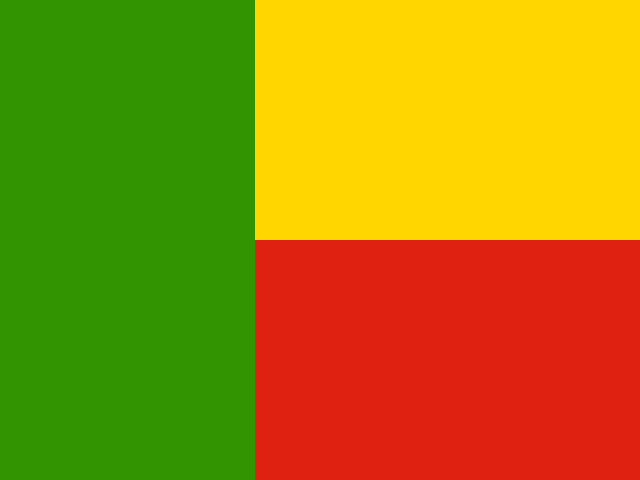
What the flag looks like
The Beninese flag consists of a vertical green band on the hoist side, and two horizontal bands of yellow (top) and red (bottom) on the fly side. The proportion is 2:3. It was originally adopted on 1 August 1960, when Benin (then Dahomey) gained independence from France, replaced during the Marxist-Leninist period (1975–1990), and readopted on 1 August 1990.
Colors and meaning
Green represents hope and renewal, yellow represents the country's mineral wealth and savanna, and red represents the blood shed by Beninese patriots in the struggle for independence and the courage of the Beninese people. The colors are Pan-African and were chosen to represent the nation's landscape and unity.
Green
Represents hope for the future and the renewal of the nation. Green also represents the country's vegetation and agricultural wealth, particularly its palm groves and farmland.
Yellow
Represents the savanna of northern Benin and the country's mineral wealth. Yellow also represents the sun and the bright future of the Beninese nation.
Red
Represents the blood shed by Beninese patriots in the struggle for independence from France, achieved in 1960, and the courage and determination of the Beninese people.
Pan-African colors
The green, yellow and red are the Pan-African colors, adopted by many newly independent African states. The design also draws on the layout of the flag of Ethiopia, which was the first African country to use these colors.
History and adoption
Benin was a French colony known as Dahomey from 1894 until 1960, when it gained independence on 1 August 1960. The current flag was adopted on independence day. In 1975, the country was renamed the People's Republic of Benin under a Marxist-Leninist government led by Mathieu Kérékou, and a new red flag with a green star was adopted. After the transition to democracy in 1990, the original 1960 flag was readopted on 1 August 1990 and has remained unchanged since.
Key facts
- Adopted
- 1 August 1960 (readopted 1 August 1990)
- Proportion
- 2:3
- Designer
- Based on Pan-African colors and the flag of Ethiopia
- Capital
- Porto-Novo
- Country code
- BJ
- Similar flags
- Ethiopia, Mali, Senegal
Historical and related flags
Benin has used three flags since independence, with the current design restored after the Marxist-Leninist period.
- French Dahomey (1894–1960): French flag used during colonial rule.
- First national flag (1960–1975): Current design adopted at independence.
- People's Republic of Benin (1975–1990): Red flag with a green star in the upper hoist.
- Current flag (1990–present): Original 1960 design restored.
- Presidential standard: Uses the Beninese coat of arms with two leopards and a ship.
Frequently asked questions
What does the flag of Benin look like?
The flag of Benin has a vertical green band on the hoist, with horizontal yellow (top) and red (bottom) bands on the fly. The proportion is 2:3.
When was the flag of Benin adopted?
The current flag of Benin was officially adopted on 1 August 1960 (readopted 1 August 1990).
What do the colors mean?
Green represents hope and renewal, yellow represents the country's mineral wealth and savanna, and red represents the blood shed by Beninese patriots in the struggle for independence and the courage of the Beninese people. The colors are Pan-African and were chosen to represent the nation's landscape and unity.
Which flags look similar to the Benin flag?
Ethiopia uses green-yellow-red horizontal bands with a central blue disc and star. Mali and Senegal use green-yellow-red vertical bands. Benin's green vertical band with yellow and red horizontal fly bands is unique in its arrangement.

 Togo
 Nigeria
 Burkina Faso
 Niger
 Ivory Coast
 Ethiopia