What the flag looks like
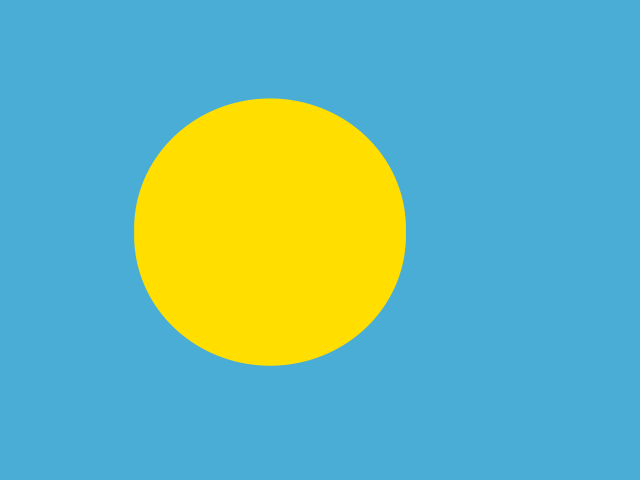
The Palauan flag consists of a light blue field with a large golden-yellow circle positioned slightly off-center toward the hoist side. The proportion is 5:8. It was adopted on 1 January 1981, when Palau became a self-governing republic, and was retained when the country gained full independence in 1994 under a Compact of Free Association with the United States.
Colors and meaning
The light blue field represents the Pacific Ocean that surrounds Palau, and the golden-yellow circle represents the full moon — a traditional symbol of peace, love and tranquility in Palauan culture, and a reminder of the time when traditional activities such as fishing, farming and celebrating were carried out under the light of the full moon.
Light blue field
Represents the Pacific Ocean that surrounds Palau — an archipelago of about 340 islands in the western Pacific, known for its pristine coral reefs, Rock Islands and biodiversity. Light blue also represents the clear skies and calm waters that surround the country.
Golden-yellow circle
Represents the full moon — a central symbol in Palauan culture. In traditional Palauan society, the full moon was a time of celebration, fishing, harvesting and community activities. The moon represents peace, love and tranquility, and is considered one of the most important symbols in Palauan tradition. The moon is also associated with the Palauan goddess of the moon and is a common motif in Palauan art, storyboards and traditional bai (men's meeting houses).
Off-center position
The circle is positioned slightly toward the hoist side of the flag, rather than in the exact center. This deliberate placement gives the flag a dynamic quality and reflects a design tradition shared with other Pacific flags (such as Bangladesh's flag), which positions the central element off-center so it appears centered when the flag is flying from a mast.
Design origin
The flag was designed in a competition in 1980, when Palau was preparing to become a self-governing republic within the US-administered Trust Territory of the Pacific Islands. The winning design was created by Blau Skebong, a Palauan artist, and was adopted on 1 January 1981, when the Constitution of Palau came into force. The flag was retained when Palau became fully independent on 1 October 1994.
History and adoption
Palau was part of the Spanish East Indies from the 16th century until 1899, when it was sold to Germany after the Spanish–American War. It was occupied by Japan during World War I and administered by Japan as a League of Nations mandate from 1919 until 1944. After World War II, it became part of the United States-administered Trust Territory of the Pacific Islands. In 1981, Palau adopted a constitution and became a self-governing republic, and the current flag was adopted on 1 January 1981. Palau became fully independent on 1 October 1994 under a Compact of Free Association with the United States, and the flag was retained. It has remained unchanged since.
Key facts
- Adopted
- 1 January 1981
- Proportion
- 5:8
- Designer
- Blau Skebong
- Capital
- Ngerulmud
- Country code
- PW
- Similar flags
- Bangladesh, Japan
Historical and related flags
Palau used several flags during its Spanish, German, Japanese and American periods before self-government.
- Spanish East Indies (1521–1899): Spanish colonial flags.
- German New Guinea (1899–1914): German colonial flags.
- Japanese South Seas Mandate (1919–1944): Japanese flag used.
- US Trust Territory (1947–1981): United States flag and Trust Territory flag used.
- Current flag (1981–present): Light blue field with a golden-yellow full moon circle.
- Presidential standard: Uses the Palauan coat of arms with a traditional bai meeting house.
Frequently asked questions
What does the flag of Palau look like?
The flag of Palau is a light blue field with a large golden-yellow circle slightly off-center toward the hoist. The proportion is 5:8.
When was the flag of Palau adopted?
The current flag of Palau was officially adopted on 1 January 1981.
What do the colors mean?
The light blue field represents the Pacific Ocean that surrounds Palau, and the golden-yellow circle represents the full moon — a traditional symbol of peace, love and tranquility in Palauan culture, and a reminder of the time when traditional activities such as fishing, farming and celebrating were carried out under the light of the full moon.
Which flags look similar to the Palau flag?
Bangladesh uses a red circle on a green field, and Japan uses a red circle on a white field. Palau's golden-yellow circle on a light blue field is unique, and its symbolic meaning — the full moon rather than the sun — distinguishes it from both.

 Micronesia
 Marshall Islands
 Nauru
 Kiribati
 Japan
 Bangladesh